A used electric car can look affordable until you ask harder questions. How healthy is the battery? Can you charge at home? What happens when electricity is unavailable? Will the car suit a Harare commute, or become difficult on longer trips?
A ZERA page published on January 16, 2025, described Zimbabwe’s electric-vehicle standards, regulations and pilot charging infrastructure as still under development (ZERA, “Electric mobility framework to accelerate adoption of EVs”, 2025). That makes planning more important than enthusiasm.
This guide is about importing and owning a used electric car in Zimbabwe, using the Nissan Leaf as the main example. It covers battery evidence, daily driving, home charging, range planning, import rules and long-term ownership costs. It also explains when a hybrid or petrol car may be the safer choice.
Quick Answer
- A used EV can make sense if you have reliable home charging and predictable daily travel.
- Battery health matters more than mileage alone. State of Health, cell balance and charging behaviour deserve attention.
- A Nissan Leaf dashboard can show up to 12 battery-capacity bars, but that display is only an initial clue (Recurrent, “Used Nissan Leaf Range & Battery Health”, 2026).
- A ZERA page published in January 2025 described charging infrastructure as still developing, so don’t assume a public charger will be available when you need one (ZERA).
- Compare the complete landed and ownership cost, not only the vehicle price.
Is a Used Electric Car Practical for Zimbabwean Driving?
A used EV is most practical when your daily route is predictable, home charging is available and you keep a sensible reserve. A ZERA page published on January 16, 2025, described Zimbabwe’s charging infrastructure as a developing area involving standards, regulations and pilot projects (ZERA, “Electric mobility framework to accelerate adoption of EVs”, 2025). Route planning is therefore a core buying decision.
Harare stop-start traffic can suit an electric drivetrain. An EV can move quietly through crowded streets without engine idling, gear changes or regular trips to a fuel station. That does not make every EV suitable, though. Your parking, charging access and weekly travel pattern matter more than the badge.
Start by writing down your normal routine for one week. Record your daily kilometres, longest regular trip, work parking, home parking and journeys outside Harare. Include school runs, shopping, unexpected detours and visits to nearby towns.
Why drive to the last few kilometres of displayed range? A safer plan leaves room for traffic, weather, passengers, hills and a delayed return trip. The dashboard estimate changes with recent driving conditions. Use it as a guide, not a fixed promise.
| Driving pattern |
EV suitability |
What must be true |
| Short daily Harare commute |
Stronger fit |
Reliable home charging and a reserve |
| Mixed city and highway use |
Possible |
Route planning and suitable battery evidence |
| Frequent long-distance travel |
More demanding |
Confirmed charging and backup options |
| No home or workplace charging |
Weak fit |
Public charging must be verified first |
The useful question is not, “How far can this EV go?” It is, “Which trips must this EV complete without relying on an uncertain charger?” That wording exposes problems early and helps you compare the car with a hybrid or petrol alternative.
A Nissan Leaf for Zimbabwe can be worth considering, but the exact battery, manufacture year and inspection evidence still matter more than the model name.
Battery Condition in a Used Electric Car
Battery condition means remaining usable capacity, cell behaviour and charging performance, not simply the odometer reading. State of Health, or SoH, is the battery’s remaining usable capacity compared with when it was new. In 2026, Recurrent’s community data showed Nissan Leafs retaining 93% of original range after three years and 91% after five years, based on more than one billion miles of overseas driving data (Recurrent, “Used Nissan Leaf Range & Battery Health”, 2026).
Those figures are not Zimbabwe forecasts. They show why battery age and condition deserve separate attention. A battery with reduced capacity may still work well for a short daily commute, while the same battery could become frustrating on longer trips.
For buyer screening, ask whether the inspection records any cell imbalance, charging interruption, warning light or diagnostic fault code. A battery that stores less energy is not automatically faulty. A battery that refuses to charge consistently deserves much closer attention.
Climate and charging history also matter. Recurrent notes that Nissan Leaf generations through 2024 use passive air cooling rather than liquid battery cooling (Recurrent, “Used Nissan Leaf Range & Battery Health”, 2026). Heat exposure can form part of the assessment when the vehicle’s previous storage and charging conditions are unknown.
An auction grade is only one piece of evidence. It is not a battery certificate and does not prove SoH, cell balance, charging reliability or remaining practical range. Ask for battery-specific evidence separately.
Which Battery Evidence Deserves the Most Weight?
Use this evidence hierarchy when comparing a used EV. It is an editorial screening framework, not a laboratory scoring system.
| Evidence source |
What it can tell you |
Weight |
| Battery-management diagnostic report |
SoH, cell balance and fault codes, where supported by the exact vehicle and available tooling |
Strongest |
| Qualified inspection report |
Visible condition and recorded faults |
Strong |
| Capacity-bar display |
A quick indication of lost capacity |
Useful screening clue |
| Observed charging session |
Whether charging starts and continues normally |
Useful practical check |
| Full-charge range estimate |
Recent energy-use prediction |
Supporting evidence |
| Odometer reading |
Distance travelled only |
Limited |
| Seller description |
Claimed condition |
Weakest until verified |
The dashboard range is a prediction based on recent use. It is not a direct measurement of usable battery capacity. Mileage is even less useful on its own because two cars with similar mileage can have different battery histories, temperatures and charging patterns.
Citation capsule: Battery condition combines remaining capacity, cell balance and charging behaviour. Recurrent’s 2026 Nissan Leaf guide reports gradual range loss in overseas community data, but those results do not predict local performance. A shorter-range battery may suit a commuter; serious charging faults create a different risk.
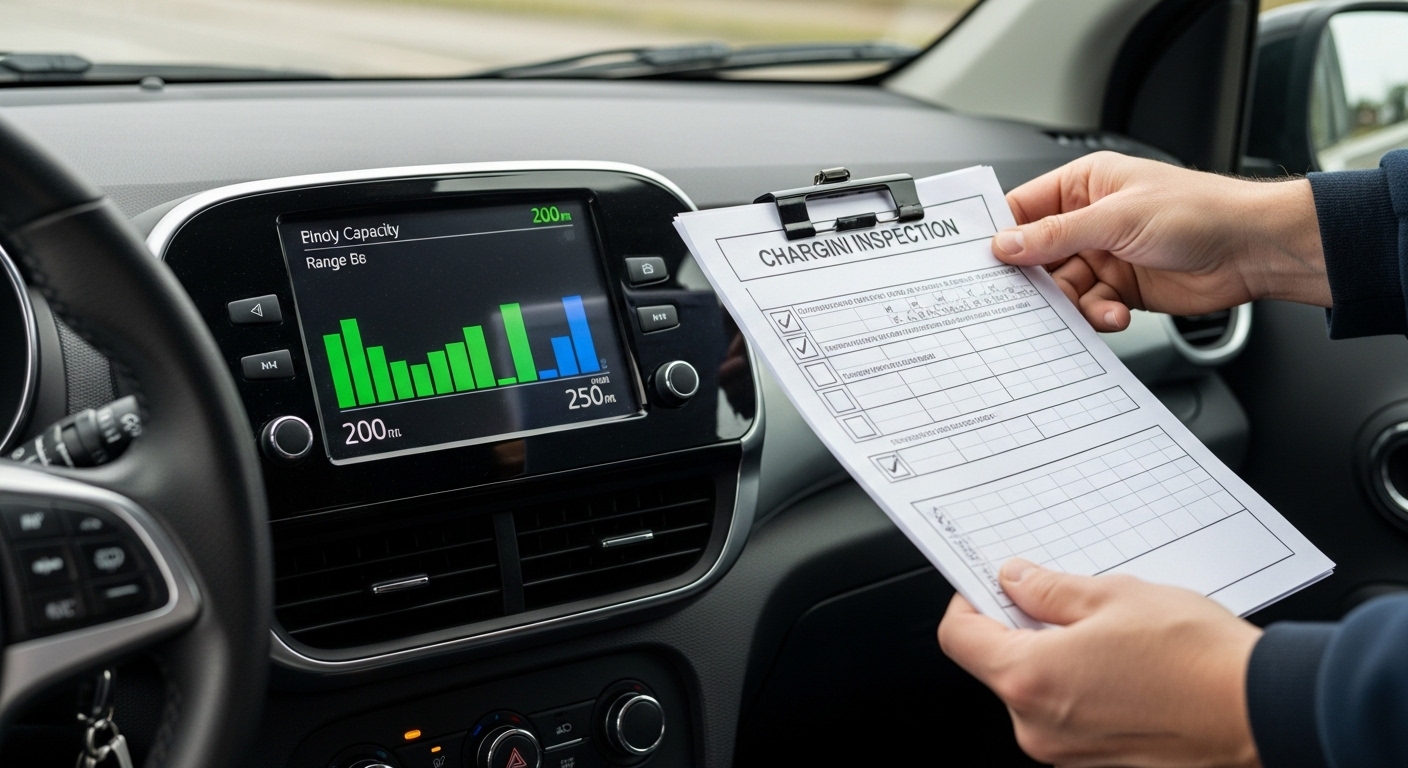
Compact car dashboard with battery chart and a charging inspection checklist in hand.
How Do You Check the Battery on a Used Nissan Leaf?
Start with diagnostic evidence, then check whether the dashboard, charging behaviour and inspection documents tell the same story. In 2026, Recurrent described the Nissan Leaf’s battery display as a gauge with up to 12 bars when new (Recurrent, “Used Nissan Leaf Range & Battery Health”, 2026). The bars are useful, but they cannot replace a proper battery-health check.
The Nissan Leaf is a familiar Japanese EV, but each vehicle must be assessed individually. Do not assume every Leaf has the same battery capacity, charging equipment or practical range.
What Should You Confirm About the Exact Car?
Before relying on a listing, confirm:
- Manufacture year and model generation
- Exact variant and model code
- Battery size, only where verified from vehicle-specific evidence
- Charging-port type
- Odometer reading
- Auction grade
- Auction-sheet comments
- Inspection findings
- Included charging cable and equipment
- Any battery or charging warning
The manufacture year matters for battery age and Zimbabwe’s import rules. The variant matters because different Leaf versions can use different battery capacities and equipment. A generic model-page description is not enough for a final decision. The Nissan specifications and model information page can help with general model research, but the exact vehicle documents should decide the purchase.
What Do the Capacity Bars Tell You?
A Leaf can display up to 12 battery-capacity bars. Missing bars indicate reduced available capacity, making the display a useful first screen when viewing the car or reviewing photographs.
It still has limits. The display does not explain cell balance, hidden fault codes or whether the charging system behaves properly. It also does not tell you whether the remaining capacity suits your route.
What Should a Diagnostic or Charging Check Include?
Ask for a battery-management diagnostic reading where one is available and supported by the exact vehicle and available tooling. Useful information may include SoH, cell balance, fault codes, temperature warnings and charging history. Do not apply a universal “buy above this percentage” rule without model-specific evidence.
A real charging check matters too. Does charging begin normally? Does it stop unexpectedly? Does the connector fit your intended equipment? Is the cable included? Does the car show warning messages?
The high-voltage battery area should also be inspected for visible impact, corrosion or underbody damage. Check the 12-volt battery as well. An EV still depends on its low-voltage electrical system, and a weak 12-volt battery can create confusing electrical faults.
Do not use mileage as a substitute for battery health.
Citation capsule: A Nissan Leaf’s 12-bar capacity display is an initial screening tool, not a complete diagnosis. Recurrent’s 2026 buyer guidance recommends checking missing bars alongside a State of Health reading and charging behaviour. Verify the exact variant, cable, connector and inspection evidence before payment.
Range Planning for Harare and Intercity Trips
Practical range is what remains after battery ageing, traffic, hills, passengers, weather and a safety reserve, not the brochure figure alone. In its overseas community data, Recurrent reports 78% winter range and 95% summer range for the Leaf (Recurrent, “Used Nissan Leaf Range & Battery Health”, 2026). Zimbabwe’s conditions differ, but the separate seasonal figures show why conditions affect planning.
Separate four ideas:
- Original rated range: the manufacturer’s test result when the battery was new.
- Current dashboard estimate: a prediction based on recent driving.
- Practical working range: what your car can normally cover in your conditions.
- Reserve range: the distance you keep for delays, detours and uncertainty.
Do not rely on an exact range figure unless the battery size, variant, test cycle and source are all confirmed. Even a correct test figure may not match your route. Highway speed, hills, air conditioning, passengers and tyre pressure can change energy use.
Use a personal range worksheet. Measure your normal daily route, record the longest regular trip and identify where you could charge. Then set a reserve that feels comfortable for your driving and electricity situation.
| Range-planning stage |
What to ask |
| Rated figure |
Which battery and test cycle produced it? |
| Current estimate |
What recent driving influenced the display? |
| Practical working range |
How do traffic, hills and air conditioning affect it? |
| Reserve |
What remains for a detour or delayed return? |
| Backup plan |
What happens during a power interruption? |
Can the car complete your longest regular journey without reaching the final few kilometres? If not, the vehicle may simply be the wrong fit for your routine.
Citation capsule: A used EV’s working range is lower and less certain than its original test figure. Recurrent’s 2026 data reports separate overseas Leaf figures of 78% winter range and 95% summer range. Zimbabwean buyers should plan around their own routes, conditions and reserve rather than copy one advertised number.
Can You Charge a Used Electric Car at Home in Zimbabwe?
Home charging is the foundation of used-EV ownership, so confirm the electrical setup before choosing the vehicle. A ZERA page published on January 16, 2025, said it planned to coordinate renewable-energy charging work and engage industry on pilot charging infrastructure at strategic locations (ZERA, “Electric mobility framework to accelerate adoption of EVs”, 2025). That is policy-development evidence, not proof of a complete public network.
Charging from a household supply may be possible, but safety comes first. The vehicle, cable, socket, circuit and installation must work together. Avoid running an unsuitable extension lead across a walkway or leaving a cable exposed to damage.
Your options may include overnight home charging, workplace charging, public AC charging or DC rapid charging. DC rapid charging is higher-power charging designed to replenish a battery faster than normal AC charging. Its usefulness depends on the vehicle, connector, supply, cable and installation. Confirm compatibility before making a payment.
Power interruptions also belong in the plan. You may need a larger reserve, an alternative vehicle, workplace charging or another way to complete essential trips.
What Does a Home-Charging Decision Test Look Like?
| Question |
Good answer |
Warning sign |
| Can you park at home? |
Secure off-street parking |
Street parking only |
| Can you charge overnight? |
Safe, suitable electrical supply |
Cable across a walkway |
| Is the connector confirmed? |
Checked before payment |
Assumed from the badge |
| Can you install equipment? |
Permission and qualified advice |
No safe installation route |
| What happens during a power cut? |
Reserve or backup plan |
No alternative for essential trips |
Zimbabwe’s national electric-mobility framework published in 2022 identified charging infrastructure, electricity access and limited automotive skills as adoption barriers (UNEP-CCC, “National Electric Mobility Policy and Market Readiness Framework for Zimbabwe”, 2022). Treat that as important background, not as a current charger count.
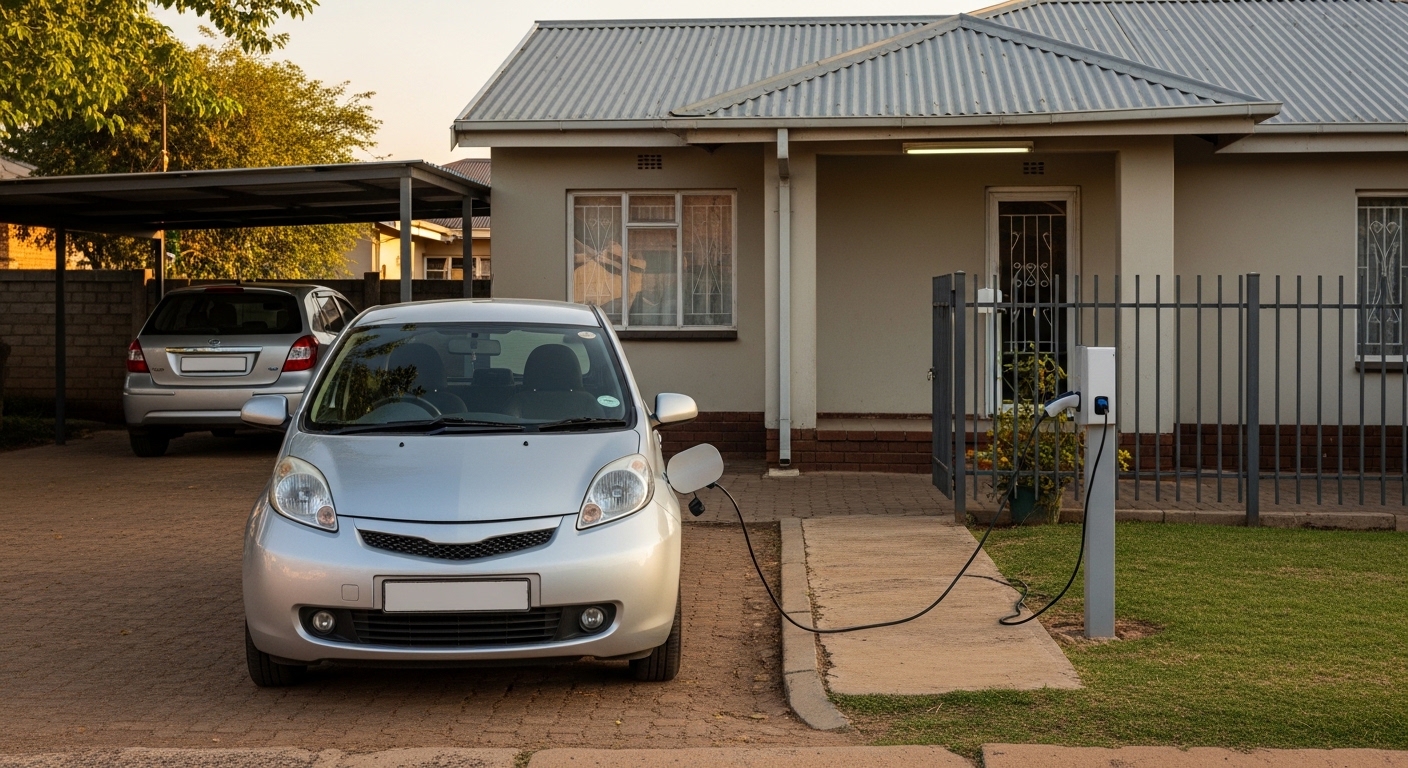
A compact silver car charges in the driveway of a modest fenced suburban home.
Citation capsule: Home charging is a decision gate for many used-EV buyers in Zimbabwe. ZERA described charging standards, regulations and pilot infrastructure as developing areas in 2025, while Zimbabwe’s 2022 national framework identified charging access and electricity supply as barriers. Confirm your own safe charging plan before choosing the vehicle.
Read more about how hybrid and electric cars compare in Zimbabwe.
Is an EV Cheaper to Own Over the Long Term?
An EV can reduce fuel and engine-maintenance costs, but it is not automatically cheaper once import costs, charging access and battery risk are included. Current ZIMRA VAT guidance permits VAT at 15%; its motor-vehicle guidance also explains valuation involving VDP, or Value for Duty Purposes (ZIMRA, “Calculation of Duty on Importation of Private Motor Vehicles”, retrieved 2026). VDP is a customs valuation basis, not the complete landed cost. Confirm the final assessment directly with ZIMRA before payment.
What Belongs in the Ownership Calculation?
1. Vehicle and import process
The vehicle price is not the same as the landed or on-road total. Separate shipping, inspection and service inclusions from ZIMRA valuation, VAT and clearance costs. Use the vehicle-page estimate only as a starting point.
2. Charging energy
Use your actual driving distance and current electricity tariff. Electricity access, tariff changes, charging losses and vehicle efficiency all affect the result.
A simple framework is:
Monthly energy used × current electricity tariff = estimated charging cost
For a more useful estimate:
Daily kilometres × vehicle consumption per kilometre × driving days = monthly driving energy
Add charging losses rather than assuming all energy drawn from the supply reaches the battery.
3. Routine servicing
Routine servicing remains part of EV ownership. Check the exact vehicle’s maintenance schedule and confirm that local technicians can handle its brakes, tyres, suspension, electrical systems and 12-volt battery before importing it.
4. Battery risk
A major battery repair or replacement can change the ownership calculation. Costs depend on model, battery size, parts availability, labour and technical support. Do not use a generic replacement figure for every Leaf or every EV.
5. Resale and technical support
Ask whether technicians can access suitable diagnostic tools. Consider whether compatible charging equipment and replacement parts are available. A clear battery report may also help the next buyer understand the car’s condition.
The cheapest-looking EV may not be the cheapest ownership choice. A newer car with stronger evidence and fewer years before the five-year surtax threshold may offer better risk control than an older car with a lower starting cost.

A person checks paperwork at a desk with car keys as a compact EV sits outside the window.
| Cost area |
Questions to answer |
| Vehicle and import process |
What does the quote include? |
| ZIMRA and clearance |
How will VDP and VAT be assessed? |
| Charging |
What equipment and electricity access are required? |
| Routine servicing |
Who can diagnose and maintain the car? |
| Battery-risk reserve |
What happens if capacity or charging faults worsen? |
Citation capsule: An EV can cost less to fuel and service, but that does not guarantee a lower ownership cost. ZIMRA guidance permits VAT at 15% and explains VDP-based valuation. Buyers must still account for import charges, charging energy, maintenance, battery risk and technical support.
Read why a vehicle price is not the full landed cost before comparing vehicles.
How Do Zimbabwe’s Age Rules Affect a Used EV Purchase?
A used passenger EV must meet Zimbabwe’s import-age rules before battery condition or running costs matter. ZIMRA states that passenger vehicles aged 10 years or more from the date of manufacture are generally prohibited from import (ZIMRA, “Importation of Motor Vehicles by Private Individuals”, retrieved 2026). ZIMRA also states that the surtax threshold applies to passenger vehicles more than five years old at importation (ZIMRA, “Calculation of Duty on Importation of Private Motor Vehicles”, retrieved 2026).
Manufacture year is critical. Registration year is not a substitute. A vehicle can appear newer in an advert while its manufacture date creates a different eligibility or cost position.
Ordinary passenger vehicles aged 10 years or more from manufacture are generally prohibited from import. Limited exceptions apply, such as certain returning residents, diplomats, deceased estates and qualifying historic vehicles. Confirm any exception and required import licence with ZIMRA and the Ministry of Industry and Commerce.
The five-year threshold can change the landed-cost calculation. This is one reason a slightly newer vehicle may be better value than an older car with a lower initial price. Never rely on a generic duty or surtax percentage. Confirm the current calculation with ZIMRA.
Check Zimbabwe’s current vehicle import rules and the latest ZIMRA guidance before payment.
Citation capsule: Zimbabwe’s import rules make manufacture year central to a used-EV decision. ZIMRA says vehicles aged 10 years or more from manufacture generally may not be imported, while passenger vehicles more than five years old cross the surtax threshold. Verify both points before comparing battery condition and ownership costs.
Read how the Japan-to-Zimbabwe buying process works before ordering.
When Should You Choose a Hybrid Instead of a Used EV?
A hybrid may be the better fit when you want lower fuel use without depending on home charging or a developing public network. A ZERA page published on January 16, 2025, described pilot charging infrastructure and supporting standards as work still being developed (ZERA, “Electric mobility framework to accelerate adoption of EVs”, 2025).
An EV makes more sense when you have secure overnight parking, dependable home charging, predictable routes and verified battery evidence. It can suit urban commuting when the longest regular trip remains comfortably within your planned working range.
A hybrid deserves closer attention when you regularly travel between Harare, Bulawayo, Mutare or other cities. It may also suit you better when power interruptions are frequent, your daily routes change often or you lack access to EV diagnostic support.
| Buyer condition |
More suitable choice |
Main reason |
| Predictable urban commute |
Used EV |
Home charging can cover routine travel |
| Frequent long highway travel |
Hybrid |
Refuelling is simpler on longer routes |
| No dependable home charging |
Hybrid or petrol |
Public charging must not be assumed |
| Verified battery and secure parking |
Used EV |
Battery risk is better understood |
| Uncertain technical support |
Hybrid or petrol |
Familiar servicing may be easier |
| Regular power interruptions |
Hybrid |
Less dependence on charging availability |
Buyer-fit verdict
Choose a used EV if you can charge at home, drive predictable distances and verify the battery. Choose a hybrid if your routes are less predictable or long-distance travel is a regular part of life.
Read more about hybrid versus electric cars in Zimbabwe, then return to the battery and charging checklist before deciding.
Citation capsule: A hybrid can be the safer choice when long-distance travel, changing routes or unreliable charging access are part of daily life. ZERA described Zimbabwe’s EV standards and pilot charging infrastructure as developing in 2025. A used EV is strongest for buyers who can charge at home and plan predictable routes.
What Should You Verify Before Ordering a Used EV from Japan?
Before ordering, verify the vehicle documents, battery evidence, import eligibility, charging compatibility and full cost assumptions. In 2026, the buying guide states that the process includes two inspection reports before payment. The FAQ gives an estimated Japan-to-Durban transit time of about 24 to 34 days (Carbarn FAQ, 2026), but the timeline can vary.
What Should the Vehicle Documents Show?
Carbarn lists Japan-stock vehicles that can be ordered for Zimbabwe. Review the exact listing and documents rather than assuming how the vehicle was sourced.
Before payment, review:
- The official Japanese auction sheet
- The in-house inspection report
- Manufacture year
- Exact variant and model code
- Odometer reading
- Auction grade
- Charging equipment and connector information
- Any battery or charging evidence
- EAA inspection and certification requirements
- The proforma invoice and included services
An auction sheet and general inspection report improve transparency. They do not automatically provide SoH, capacity-bar or cell-balance information. If those details are absent, ask what additional battery evidence can be confirmed before payment.
You can review an individual Nissan Leaf listing without treating it as a blanket recommendation. Check the fuel label, manufacture year, variant and inspection evidence for that exact vehicle.
How Does the Route Affect Planning?
RoRo means roll-on/roll-off shipping, where vehicles are driven onto a vessel for transport. One stated route is Japan to Durban by RoRo, followed by overland transport into Zimbabwe. The estimated transit time is about 24 to 34 days, but delivery timing can change.
The buying guide says buyers can access invoices, the bill of lading, inspection reports, EAA documents and vessel tracking through the dashboard. Review each document before assuming that a vehicle or service quote covers every border cost.
No verified ZWG stock prices are used in this article. A vehicle or service price is not the complete on-road total. Duty, VAT and customs-clearance costs are paid separately. Use the vehicle page’s estimated landed-cost panel as a starting point, then confirm current calculations with ZIMRA.
The FAQ says full upfront payment is currently required and that manufacturer warranties are not provided for used imports (Carbarn FAQ, 2026). Do not treat a report, inspection or dashboard as a warranty or financing arrangement.
What Should You Do Next?
- Browse the Nissan Leaf listings.
- Open individual vehicle pages and review the exact documents.
- Confirm battery evidence, charging compatibility and manufacture year.
- Read how the buying process works.
- Check Zimbabwe’s current import rules.
- Ask ZIMRA or a qualified clearing agent about the current valuation and clearance position.
Citation capsule: Carbarn’s Zimbabwe buying process presents Japan-stock vehicles with an auction sheet and inspection report before payment. Its FAQ describes Japan to Durban by RoRo, then overland into Zimbabwe, as an estimated route of about 24 to 34 days (Carbarn FAQ, 2026). Buyers must still verify battery evidence and pay duty, VAT and clearance separately.
The Practical Verdict
A used EV can suit Zimbabwe, but the decision depends on evidence and routine rather than enthusiasm. In 2026, Nissan’s owner manual states that battery capacity decreases with age and use, reducing initial range as expected battery behaviour (Nissan, “2021 Nissan LEAF Owner Manual”, 2021). Battery condition should therefore guide the purchase.
Check whether you can charge safely at home. Measure your daily and longest regular routes. Ask for battery evidence beyond mileage and dashboard range. Include VAT, clearance, charging, servicing and battery risk in the ownership calculation.
The lowest starting cost may not produce the lowest long-term cost. A hybrid may make more sense when your travel is unpredictable or public charging cannot be verified.
Before payment, review the vehicle documents, current import rules and the exact charging setup you will use. Then compare the complete plan, not just the car.
See the current Nissan Leaf listings for Zimbabwe only after checking the vehicle-specific evidence.
Source note: The following sources were checked for this article and should be refreshed before publication:
- ZERA, “Electric mobility framework to accelerate adoption of EVs”, retrieved 2026-08-13, https://www.zera.co.zw/electric-mobility-framework-to-accelerate-adoption-of-evs/
- Recurrent, “Used Nissan Leaf Range & Battery Health”, retrieved 2026-08-13, https://www.recurrentauto.com/guides/nissan-leaf
- Nissan, “2021 Nissan LEAF Owner Manual”, retrieved 2026-08-13, https://www.nissanusa.com/content/dam/Nissan/us/manuals-and-guides/leaf/2021/2021-nissan-leaf-owner-manual.pdf
- Nissan, “Nissan LEAF Owners Manual Publications”, retrieved 2026-08-13, https://www.nissan-techinfo.com/deptog.aspx?dept_id=148
- ZIMRA, “Calculation of Duty on Importation of Private Motor Vehicles”, retrieved 2026-08-13, https://www.zimra.co.zw/customs/calculation-of-duty-on-importation-of-private-motor-vehicles-and-suspension-of-duty-on-motor-vehicle-imports-by-the-physically-handicapped-persons
- ZIMRA, “Importation of Motor Vehicles by Private Individuals”, retrieved 2026-08-13, https://www.zimra.co.zw/customs/importation-of-motor-vehicles-by-private-individuals
- ZIMRA, “Tariff Handbook”, retrieved 2026-08-13, https://www.zimra.co.zw/customs/classification-of-goods/tariff-handbook
- UNEP-CCC and Government of Zimbabwe, “National Electric Mobility Policy and Market Readiness Framework for Zimbabwe”, retrieved 2026-08-13, https://unepccc.org/wp-content/uploads/2022/06/national-electric-mobility-policy-and-market-readiness-framework-for-zimbabwe.pdf
- Carbarn, “Nissan Leaf Price in Zimbabwe | Japan Stock”, retrieved 2026-08-13, https://www.carbarn.co.zw/cars/nissan/leaf
- Carbarn, “How to Buy a Japanese Car from Carbarn Zimbabwe”, retrieved 2026-08-13, https://www.carbarn.co.zw/how-to-buy
- Carbarn, “Car Import Rules and Regulations in Zimbabwe”, retrieved 2026-08-13, https://www.carbarn.co.zw/import-rules-and-regulations
- Carbarn, “2022 Nissan Leaf in Zimbabwe”, retrieved 2026-08-13, https://www.carbarn.co.zw/vehicles/2022-nissan-leaf-10629