

Hybrid vs Electric Cars in Zimbabwe: Costs, Charging, Fuel Savings & Which Is Better?
Read Our Blogs today and Learn More

Loading ...
Frequently Asked Questions (FAQs)

The phrase “self-charging” can be misleading. A conventional hybrid does not create free energy, and it still needs petrol. It simply recovers energy during braking and uses a smaller battery to reduce engine workload.
Which Costs Less to Run in Zimbabwe?
As of 7 August 2026, ZERA listed petrol blend at 51.83 ZWG per litre and electricity at 109.04 ZWG for the first 50 units. An EV can cost less per kilometre when charged at home, but a hybrid may cost less to live with when backup power and charging access are uncertain (ZERA, “Current Energy Prices”, 2026).
Use this simple formula:
Energy cost per 100 km = energy used per 100 km × current energy price
For a petrol car using an illustrative 8 litres per 100 kilometres, the calculation is 8 × 51.83, or 414.64 ZWG per 100 kilometres. A hypothetical hybrid using 4.5 litres would calculate at 233.24 ZWG.
Those are planning examples, not model-specific promises. Actual consumption changes with traffic, air conditioning, tyre pressure, passengers, road quality and driving style. A manufacturer test figure should never be treated as a guaranteed Zimbabwe result.
For an EV, include charging losses. For a simple illustration, assume that 20 kilowatt-hours of driving energy requires 22 kilowatt-hours from the wall. Actual losses vary by vehicle, charger and conditions. At the first electricity tariff band, that produces an illustrative calculation of about 47.98 ZWG per 100 kilometres.
Can a lower electricity bill settle the whole decision? Not necessarily. Add the cost of a wall charger, electrical upgrades, solar panels, battery storage, public charging and specialist repairs. Also consider the vehicle’s import cost, battery condition and expected annual distance.
This worksheet is useful because you can update it whenever fuel or electricity tariffs change. It is more reliable than a permanent “save this much every year” claim, especially when household electricity moves into higher tariff bands.
 Comparing vehicle expense papers and a receipt beside car keys at home.
For a fair comparison, look at total cost of ownership, not only energy use. The cheapest energy source may not produce the cheapest ownership experience once charging equipment, backup power, servicing and battery condition are included.
EV Charging Practicality in Zimbabwe
In January 2025, ZERA described pilot charging infrastructure planned at strategic locations, alongside work on standards and regulations. That source describes planned pilots, not the size or coverage of Zimbabwe’s network in August 2026. Check current charger availability before relying on an EV for a particular route (ZERA, “Electric mobility framework to accelerate adoption of EVs”, 2025).
What does home charging require?
Start with secure off-street parking. You need a safe place to leave the vehicle, route the cable and prevent accidental damage. A normal household socket and a dedicated wall charger are not identical solutions.
Ask a qualified electrician to check the household supply before installing regular charging equipment. The installation should match the vehicle, charger and protection requirements. Confirm the applicable Zimbabwe electrical requirements with the electrician and charger supplier before installation.
How does load-shedding change the decision?
An outage may delay charging even when the car is parked at home. Solar panels and battery storage can improve control, but they add equipment, space requirements and upfront cost.
A self-charging hybrid continues using petrol during a power cut. That does not make it more efficient in every situation, but it removes one daily dependency.
Can public charging support long trips?
Treat public charging as a route-planning issue. Confirm charger locations, access rules, connector compatibility and operating status before leaving. A policy target or pilot project is not proof that a charger will be available on your route.
The strongest Zimbabwean EV question is not, “Is electricity cheaper than petrol?” It is, “Can you charge when you need to?” If the answer depends entirely on public charging, an EV may create more planning stress than savings.
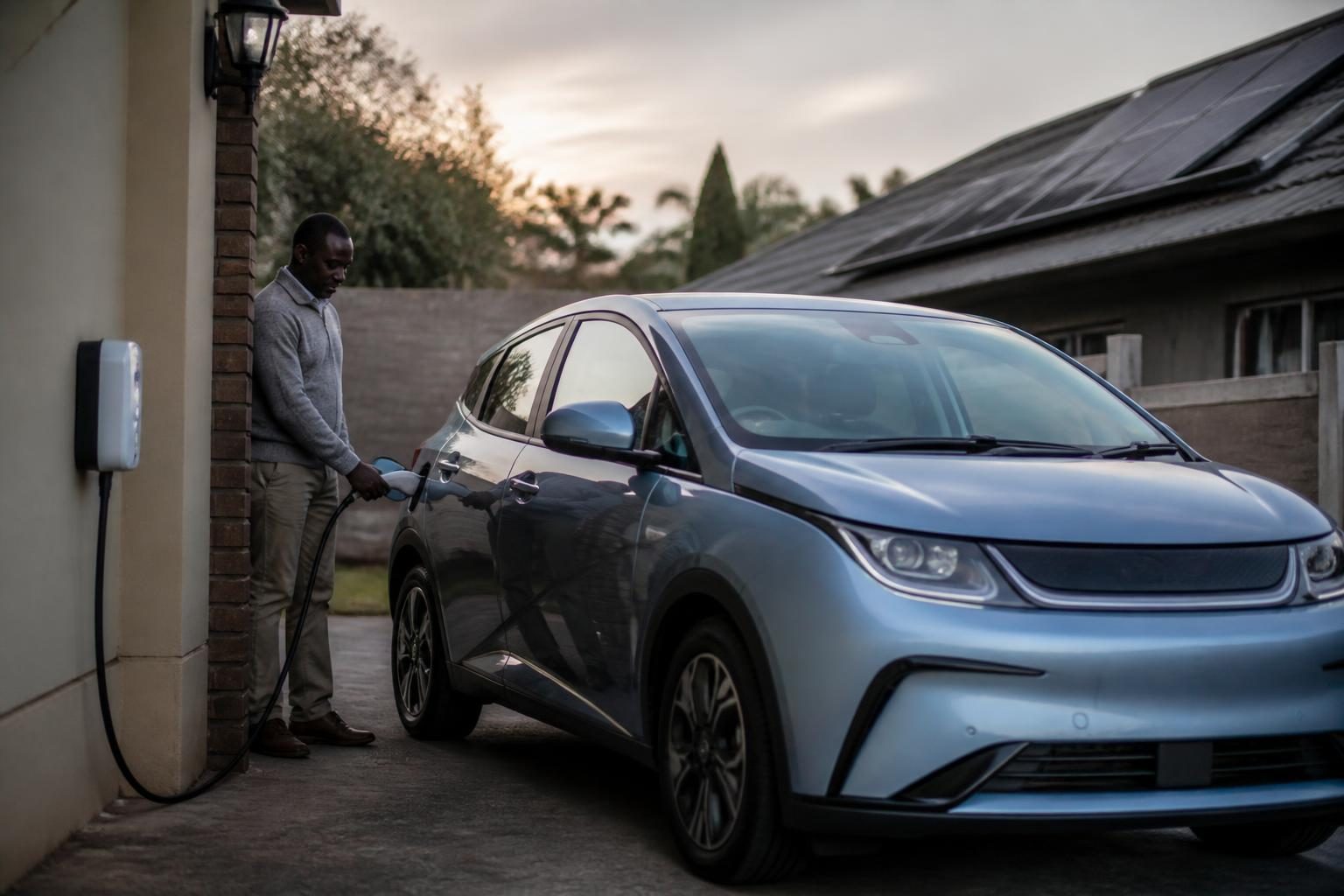 A driver charges a compact electric car at home beneath rooftop solar panels.
Which Option Suits Harare Traffic and Highway Trips?
Toyota’s official Japanese Aqua catalogue lists 35.4 km/L under the JC08 test cycle for early models, but that is not a Zimbabwean real-world result. It shows why hybrids can suit urban fuel-saving, while the better choice for mixed travel depends mainly on charging access and route flexibility (Toyota Japan, “Aqua fuel economy information”, 2026).
Both a hybrid and an EV can suit stop-start Harare traffic. An EV may be especially pleasant around town when charging is reliable. A hybrid offers similar urban assistance without requiring you to change your parking or electricity routine.
| Buyer situation | Likely fit | Why |
|---|---|---|
| Mostly stop-start Harare traffic | Hybrid or EV | Both can reduce petrol use |
| Reliable home charging and backup power | EV | Charging is more predictable |
| Frequent intercity travel | Hybrid | Refuelling is simpler |
| No secure off-street parking | Hybrid | Home charging becomes difficult |
| Wants to avoid petrol completely | EV | No combustion engine |
| Wants a gradual change from petrol | Hybrid or PHEV | More flexibility |
| Rural or uncertain routes | Hybrid | Less dependent on chargers |
| Reliable workplace charging | EV may work | Depends on access every day |
A PHEV only makes sense when you will charge it often. Driving it as a heavy petrol car without regular charging can undermine its main benefit.
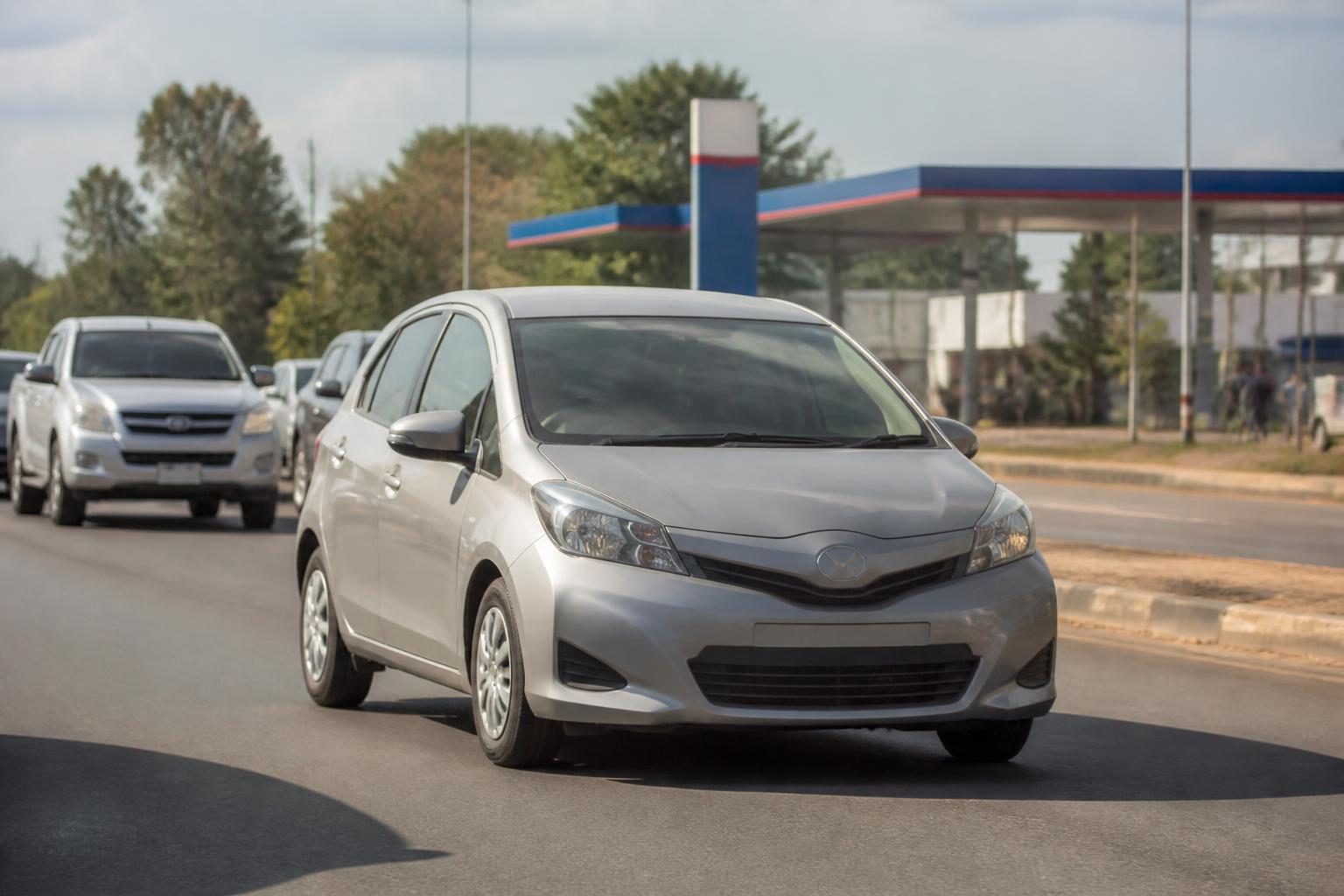 A compact hatchback moves through morning traffic past a roadside fuel station.
Choose a hybrid if you travel between cities, use rural routes, lack secure parking or want the least disruptive transition. Choose an EV if your daily routes are predictable and home or workplace charging is dependable.
What Do Battery Condition and Import Rules Change?
In 2026, ZIMRA’s private-vehicle guidance stated that used vehicles aged 10 years and above from the date of manufacture cannot be imported. Some exceptions may apply under separate ZIMRA rules. Confirm eligibility directly with ZIMRA before payment. Battery condition and age eligibility must therefore be checked together before you compare a hybrid or EV (ZIMRA, “Importation of Motor Vehicles by Private Individuals”, 2026).
Before payment, ask for:
- Battery-health evidence, where available.
- Auction-sheet comments.
- Inspection-report findings.
- Charging cable and connector details.
- Dashboard warning-light checks.
- Charging behaviour.
- 12-volt battery condition.
- Service and odometer history.
- Underbody damage, corrosion and accident repairs.
A hybrid still has a petrol engine, transmission and cooling system to service. Its battery affects fuel economy and future repair risk, but a healthy hybrid system does not remove normal maintenance.
An EV has fewer engine-related service items, but battery capacity affects practical range. The charging equipment, connector and local technical support also deserve attention. Do not use a universal battery-health cut-off without considering the exact model and your daily route.
ZIMRA states that surtax applies to passenger vehicles more than five years old at importation. The rate can change, so do not assume an older car is cheaper overall (ZIMRA, “Calculation of Duty on Importation of Private Motor Vehicles”, 2026).
VAT is 15%. ZIMRA explains that vehicle valuation uses Value for Duty Purposes, or VDP, which includes CIF and certain incidental charges such as port handling, storage and related transport costs. VAT is calculated on Value for Tax Purposes, or VTP, which adds calculated customs duty to VDP. The vehicle amount you first see is therefore not the final landed or registered total (ZIMRA, “Calculation of Duty on Importation of Private Motor Vehicles”, 2026).
Read the current Zimbabwe import rules and landed-cost guidance before paying. Rules, valuation and required documents can change.
What Should You Check Before Ordering a Japanese Hybrid or EV?
Current import guidance gives an estimated 24 to 34 days for a Japan-to-Zimbabwe shipment through Durban and describes two inspection reports before payment. The import process is therefore part of the technology decision, because buyers need evidence about battery condition, eligibility and landed costs before choosing a vehicle (Carbarn, “Import Rules and Regulations”, 2026).
Carbarn lists and sources Japan-market vehicles for Zimbabwe buyers, providing the official Japanese auction sheet alongside an in-house inspection report before payment. EAA pre-shipment inspection and the required Certificate of Conformity are arranged before export, alongside the auction sheet and Carbarn inspection report.
The route is Japan to Durban, South Africa, followed by overland transport into Zimbabwe. The 24 to 34-day timeline is an estimate, not a guaranteed arrival date. The listed amount covers the vehicle, shipping and inspection, while duty, VAT and customs-clearance costs are separate.
The Japanese stock is right-hand drive, which matches Zimbabwe’s left-side driving system. Buyers can also use the dashboard to access invoices, inspection documents, shipping records and vessel updates.
If an EV fits your routes, browse Nissan Leaf electric cars. If a hybrid makes more sense, compare Honda hybrid cars in Zimbabwe. For the full process, read how to buy a Japanese car for Zimbabwe.
The practical verdict is straightforward. A hybrid is the safer default when charging is uncertain, parking is limited or long-distance travel is common. An EV is worth considering when home charging, backup power and daily routes are dependable. A PHEV only earns its place when you will charge it regularly.