Fuel costs make a compact hybrid attractive, especially for daily commuting around Harare. The Toyota Yaris Hybrid is worth considering for urban buyers who can verify its battery evidence and import eligibility before ordering.
Skip it if you regularly carry heavy loads, use rough roads or need generous luggage space. This guide covers fuel economy, reliability, inspection checks, import eligibility and the difference between the vehicle figure and the final landed cost.
Quick Answer
- The Toyota Yaris Hybrid suits Harare commuters who want a compact, efficient hatchback.
- Current 2WD versions reach up to 36.0 km/L under WLTC testing.
- Check both batteries, the auction sheet, manufacture date and inspection evidence.
- Duty, VAT and customs-clearance costs remain separate from the vehicle figure.
Is the Toyota Yaris Hybrid a good fit for Zimbabwe?
In 2026, Toyota Japan lists the Yaris Hybrid as a 1.5-litre, five-seat hatchback with 2WD and 4WD options (Toyota Yaris model catalogue, 2026). That makes it a sensible urban car, but not a universal choice for Zimbabwean roads.
The Toyota Yaris makes the most sense if you mostly drive around Harare, commute alone or with a small family, and value manoeuvrability. Its compact body suits crowded streets and tighter parking spaces. Electric assistance can also help during repeated low-speed acceleration and braking.
The trade-offs are clear. The hatchback has five seats, but its cabin and luggage space are smaller than a larger family car. If you regularly carry bulky loads, travel on rough gravel roads or need extra ground clearance, a larger model may fit better. The Yaris hatchback is also different from the taller Yaris Cross.
Toyota’s Japanese specification lists a 1,490 cc hybrid engine, five doors and five seats for the cited Yaris Hybrid configuration (Toyota Yaris Hybrid catalogue, February 2020, 2020). In practical terms, it is a city-focused hatchback with useful efficiency, not a load-carrying vehicle.
The Yaris Hybrid’s strongest Zimbabwe use case is not simply “hybrid driving”. It is the combination of compact size, low-speed electric assistance and easier urban ownership. That matters more in Harare traffic than a headline fuel figure alone.
Toyota Yaris ownership guide
The 2023 Toyota Yaris Hybrid example
In 2026, the selected 2023 vehicle record shows 53,000 km, a grade 4 auction rating and a 1,500 cc hybrid engine (2023 Toyota Yaris vehicle page, 2026). This is a useful example because its model code and drivetrain can be matched to the correct Japanese specification.
The 2023 Toyota Yaris Hybrid is recorded as the HYBRID X variant with model code MXPH10. It has a front-wheel-drive layout, five seats, an automatic transmission and a hatchback body. The vehicle page records 91 PS (67 kW) of power and an M15A-FXE inline three-cylinder engine working with the hybrid system.
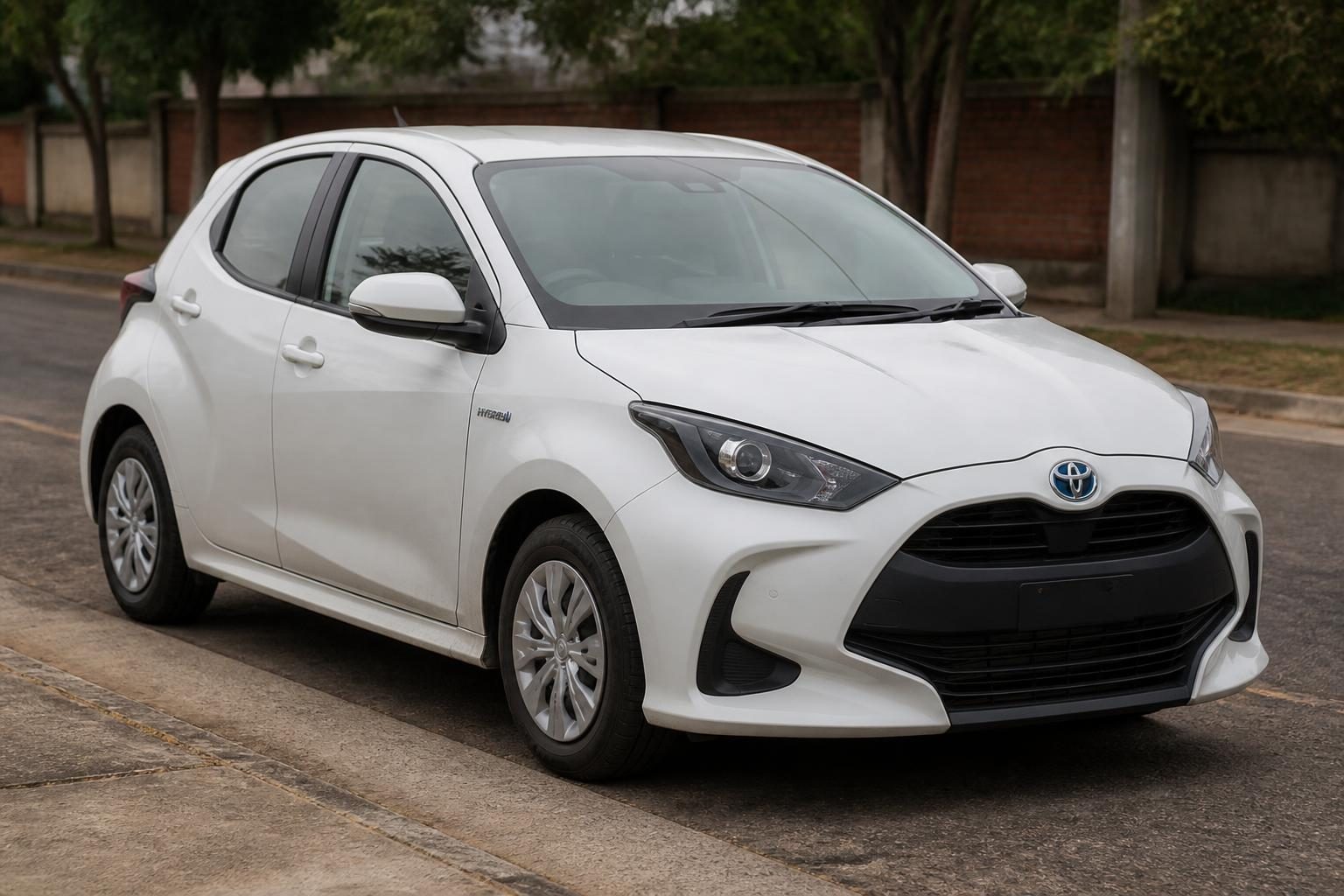 2023 Toyota Yaris
The grade 4 auction rating indicates a strong overall auction condition category, but it is not a replacement for detailed inspection notes. The vehicle page also records clean underbody condition, no dashboard damage and no interior burn holes. Tyre tread is recorded at 3 mm front and rear, so buyers should still review the full report before payment.
A manufacture year of 2023 gives this example more room under Zimbabwe’s age rules than an older car. However, the manufacture date, not the model name, should be checked against the current import regulations. Any Carbarn first-party landed-cost estimate on the vehicle page should be checked against current ZIMRA guidance and is not the final payable amount.
How economical is the Toyota Yaris Hybrid?
In 2020, Toyota Japan rated the Yaris Hybrid Z 2WD at 35.4 km/L under WLTC testing (Toyota Yaris Hybrid catalogue, February 2020, 2020). That is a controlled comparison figure, not a promise of daily fuel consumption in Zimbabwe.
WLTC is a standard test cycle used to compare vehicles in laboratory conditions. It helps buyers compare like with like, provided the model year, grade and drivetrain are labelled. Toyota’s current catalogue lists some Hybrid X 2WD versions at up to 36.0 km/L WLTC, while listed 4WD configurations are approximately 30.2 km/L (Toyota Yaris specifications, April 2026, 2026).
| Yaris Hybrid configuration |
Official test figure |
Test cycle |
| 2020 Hybrid Z, 2WD |
35.4 km/L |
WLTC |
| Current Hybrid X, 2WD |
Up to 36.0 km/L |
WLTC |
| Selected Hybrid 4WD configurations |
Approximately 30.2 km/L |
WLTC |
Harare traffic can suit a hybrid system because slowing and braking allow energy recovery. The electric motor can assist during low-speed movement, while the petrol engine may stop during some stationary or low-load situations. That advantage becomes less obvious at sustained highway speeds.
Air-conditioning, hills, passengers, luggage, tyre pressure and driving speed all affect results. A long run between Harare and Bulawayo will not produce the same conditions as stop-start city traffic. Why convert an official test figure into a promised fuel saving when the daily route is different?
Official Japanese figures support comparison, not certainty. The 2WD Yaris Hybrid’s published WLTC result is higher than the listed 4WD figures, showing why buyers should match fuel data to the exact model code and drivetrain.
Toyota Yaris vehicles for Zimbabwean buyers
Is the Toyota Yaris Hybrid reliable as a used car?
In 2025, What Car?’s reliability survey gave the 2020-present Toyota Yaris a 92.5% reliability score, but 20% of surveyed Yaris Hybrid cars reported a fault (What Car? Yaris reliability survey, 2025). The data is useful context, not a prediction of Zimbabwean failure rates.
A used Yaris Hybrid has three areas to understand: the petrol engine and hybrid transmission, the high-voltage traction battery, and the separate 12-volt auxiliary battery. These systems do different jobs. A healthy-looking dashboard does not prove that every electrical component is in good condition.
Check for hybrid-system warning lights, brake warnings, unusual battery-charge behaviour and blocked cooling vents. Accident damage, flood exposure, corrosion and poor servicing can matter as much as mileage. Regenerative braking may reduce conventional brake use in some driving, but the brake system still needs inspection.
What Car?’s 2025 survey reported 12-volt battery problems in 15% of surveyed Yaris Hybrid cars. That does not indicate high-voltage traction-battery failure. Ask for diagnostic evidence rather than assuming the worst.
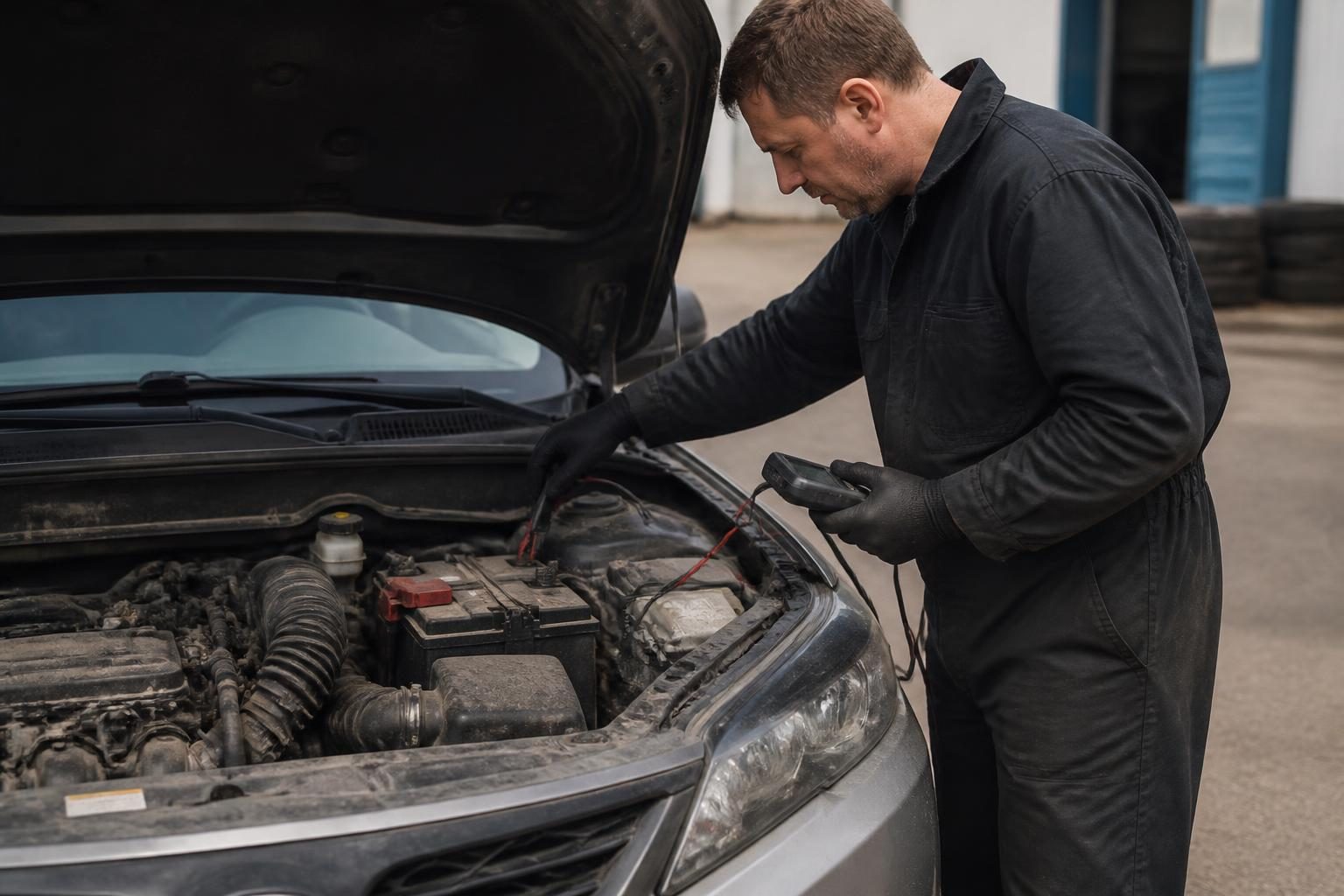 Mechanic checks a vehicle battery during diagnostics.
Why does the 12-volt battery matter?
Toyota hybrid owner information explains that a discharged 12-volt battery can prevent the hybrid system from starting, even though it is separate from the high-voltage traction battery. Buyers should ask whether warning lights, starting behaviour and battery condition were checked against the appropriate Yaris documentation.
Toyota’s hybrid system has a strong engineering foundation, but “Toyota hybrid” should never replace evidence. No used import should be treated as having a guaranteed battery lifespan or manufacturer warranty.
What should you check before importing one?
In 2026, Zimbabwe’s S.I. 59 of 2026 generally prohibits second-hand vehicles aged 10 years or more from their date of manufacture (Ministry of Industry and Commerce, S.I. 59 of 2026, 2026). Eligibility should therefore be the first check, before comparing condition or vehicle figures.
| Check |
Why it matters |
Evidence to request |
| Manufacture date |
Determines normal import eligibility |
Export documents and vehicle record |
| Hybrid system |
Identifies electrical concerns |
Diagnostic evidence and inspection notes |
| Auction history |
Shows condition, repairs and mileage |
Official auction sheet |
| Body and underside |
Helps identify corrosion or impact |
Inspection photographs and report |
| Export documents |
Supports border clearance |
CBCA/PVoC conformity certificate and shipping documents |
An auction sheet is the Japanese auction’s condition record. Review its grade, accident notation, repaired panels, corrosion comments, mileage and interior markings. The grade is useful, but it is only a high-level summary.
A separate inspection report should cross-check the auction sheet. Look for warning-light checks, underbody photographs, tyre condition, air-conditioning performance and visible hybrid-related concerns. Do not infer battery health from mileage or grade alone.
Zimbabwe drives on the left, and Japanese stock is right-hand drive. Keep the assessment focused on the vehicle’s documented configuration. For export and border compliance, confirm the required CBCA/PVoC pre-shipment conformity inspection and the certificate issued by the approved provider for that vehicle.
The most valuable pre-order evidence is not one number. It is the agreement between the manufacture date, model code, auction sheet, inspection report and diagnostic findings. If those records do not match, pause before paying.
Zimbabwe import rules and landed-cost guidance
Yaris Hybrid vs Toyota Aqua vs petrol Yaris: which suits you?
In 2026, the Yaris, Aqua and petrol Yaris/Vitz represent different ownership choices, even when their bodies appear similar (Toyota Yaris model catalogue, 2026). The right option depends on age, condition, space and import cost, not fuel type alone.
| Option |
Strongest reason to choose it |
Main compromise |
| Toyota Yaris Hybrid |
Newer compact hybrid package and strong official economy |
May cost more than an older hybrid |
| Toyota Aqua hybrid |
Familiar compact Toyota hybrid for urban use |
Older examples need careful age and battery checks |
| Petrol Yaris or Vitz |
Simpler powertrain and broad familiarity |
Gives up the hybrid’s urban efficiency advantage |
| Yaris Cross |
More ground clearance and SUV-style practicality |
A different, larger vehicle from the Yaris hatchback |
The Aqua is the Japanese-market name used for a separate, closely related compact Toyota hybrid line. It can suit city drivers, but age eligibility depends on the exact manufacture date, and battery condition should be checked from evidence rather than assumed from the model name. Compare the exact manufacture date, model code, mileage, grade and inspection report.
A petrol Yaris or Vitz may appeal if you prefer a simpler powertrain. It may give up some urban efficiency, though, so the better choice depends on your route and tolerance for hybrid diagnostics. The Yaris Cross offers more clearance, but it should not be treated as the same vehicle.
A car older than five years at import can attract a surtax. That means a slightly newer Yaris may cost less overall than an older, apparently cheaper alternative after import charges are assessed.
Toyota Yaris Hybrid import costs in Zimbabwe
ZIMRA’s current VAT rate for imported goods should be confirmed directly before payment, because the applicable rate can change. VAT is only one part of the calculation, so the vehicle listing figure is not the final on-road cost.
CIF means cost, insurance and freight. VDP, or Value for Duty Purposes, is the assessed value used when customs charges are calculated. The final amount can depend on the vehicle value, freight, insurance, age, engine details, classification and clearance charges.
Duty, VAT and customs-clearance costs are paid separately. A surtax can also apply to passenger vehicles older than five years. Because the final calculation depends on assessment and current rules, do not compare vehicles by purchase figure alone.
Review the vehicle record, then check Carbarn’s import rules and landed-cost guidance. This first-party estimate is not the final proforma amount, and current figures should be confirmed with ZIMRA before payment.
Is the Toyota Yaris Hybrid worth buying?
The Toyota Yaris Hybrid is worth considering if you mostly drive in Harare or another urban area, want a compact hatchback, and can verify the hybrid systems before ordering. Toyota’s official WLTC figures support its efficiency case, while Zimbabwe’s age rules make manufacture date equally important.
Choose it if you:
- Want easy manoeuvrability and five-seat practicality.
- Spend much of your time in stop-start traffic.
- Prefer a newer compact hybrid to an older city car.
- Can review battery evidence and inspection reports.
- Understand that import charges are separate.
Consider another vehicle if you:
- Need high ground clearance or substantial luggage space.
- Regularly carry heavy loads on rough roads.
- Prefer a simpler petrol powertrain.
- Are considering an older vehicle with eligibility or surtax complications.
The cheapest-looking hybrid is not always the cheapest choice to land. A newer, well-documented vehicle may offer a clearer import path and lower risk, even before fuel economy is considered.
What does the Japan-to-Zimbabwe buying process involve?
In 2026, the typical Japan-to-Zimbabwe journey takes about 24 to 34 days via Durban, followed by overland transport into Zimbabwe (How to Buy a Japanese Car, 2026). The process is document-led, so buyers should check the vehicle record before arranging payment.
First, select the exact model code, drivetrain, manufacture date and condition grade. Then review the auction sheet and inspection evidence. Payment is made against an official proforma invoice, with vehicle details, CIF information and tax guidance recorded for the order.
The vehicle is inspected before export, booked onto a RoRo vessel and tracked during shipping. At the border, the EAA Certificate of Conformity and other customs documents support clearance. Duty, VAT and customs charges remain separate from the vehicle and shipping figure.
Through Carbarn, buyers receive the official Japanese auction sheet and an in-house inspection report before payment. The vehicle receives the approved CBCA/PVoC pre-shipment conformity inspection required for that shipment, with the actual provider confirmed for the specific vehicle. RoRo shipping runs from Japan to Durban, followed by overland delivery into Zimbabwe. The dashboard provides invoices, inspection reports, bill of lading, certificates and vessel tracking. Carbarn’s published company details show a Japan-based address and payment arrangements.
Final verdict
The Toyota Yaris Hybrid makes a lot of sense for an urban Zimbabwean buyer who values compact size and official fuel efficiency. It deserves a closer look when the manufacture date, model code, traction battery, 12-volt battery, auction sheet and inspection report all align.
Before ordering, match the exact drivetrain to Toyota’s WLTC figure and calculate the full landed cost. For more options, browse the Toyota Yaris vehicles for Zimbabwean buyers and compare each record on its own evidence.