Finding one SUV for Harare traffic, potholes, gravel roads, family travel and long highway trips is difficult. A vehicle that feels comfortable in town may not feel confident on rural routes.
The Toyota Prado has earned a strong reputation because it combines space, full-time four-wheel drive and long-distance comfort. But does that make it the right SUV for Zimbabwe? Not automatically. Your routes, passengers, fuel tolerance and import budget matter just as much. This guide covers the Prado’s strengths, running costs, import rules and smaller alternatives. For the wider rules, see our guide to Zimbabwe vehicle import rules and landed costs.
Use four questions to narrow the choice:
- How often do you use gravel or rural roads?
- Do you need seven seats or room for heavy loads?
- Can you manage higher fuel, tyre and suspension costs?
- Does the exact vehicle meet Zimbabwe’s import-age requirement?
Quick Answer
- The Prado suits frequent gravel-road travel, rural routes, long trips and heavier loads.
- It is less suitable if you mainly drive in Harare and want easy parking or lower fuel use.
- The exact manufacture date matters because private vehicles aged 10 years or more are generally prohibited at importation.
- A RAV4 may be the more sensible choice for mixed urban and highway driving.
Is the Toyota Prado good for Zimbabwean roads?
The Toyota Prado suits Zimbabwean buyers who regularly combine paved roads with gravel, rural tracks and long-distance travel. Toyota Japan’s catalogue lists full-time 4WD, which supports that mixed-road role (Toyota Japan, Land Cruiser Prado vehicle catalogue, accessed 23 June 2026). Its size, however, is unnecessary for many urban commutes.
Full-time 4WD helps when a route changes from smooth tarmac to loose gravel or uneven ground. It also provides useful traction on wet rural roads, farm tracks and surfaces affected by heavy rain. The raised SUV stance gives you a better view of traffic and road damage, while the suspension is designed for both road comfort and rougher surfaces.
The Prado also makes sense for long journeys between Harare and other cities. Its larger cabin, stable cruising manners and available five- or seven-seat layouts suit families carrying passengers and luggage. What’s the catch? The large body is harder to place in narrow streets, crowded parking areas and busy shopping centres.
A serious 4WD cannot repair poor driving decisions. Many paved routes can be handled by smaller SUVs when driven carefully, so capability should match your regular routes rather than your occasional adventure.
Which Prado engine and body style suit Zimbabwean buyers?
The right Prado engine depends on your load, routes and fuel tolerance. Toyota Japan’s catalogue lists recent variants with a 2.7-litre petrol engine producing 163 PS and a 2.8-litre diesel producing 204 PS. It also shows five- and seven-seat configurations (Toyota Japan, Land Cruiser Prado vehicle catalogue, accessed 23 June 2026).
The diesel is the natural fit for frequent highway travel, heavier loads and buyers who value strong low-speed pulling power. The petrol version may suit simpler urban use, but you should accept its different fuel profile before choosing it. Neither engine is automatically better for every Zimbabwean driver.
A seven-seat layout is useful for larger families, but luggage space becomes tighter when all seats are occupied. Check whether you need seven seats every day, or whether a spacious five-seat SUV would work better. The exact model code, transmission, fuel type and manufacture date should always be verified.
Prado generations and the Land Cruiser 250
The Toyota Prado has several generations, and their engines, equipment and model codes differ. Toyota’s catalogue covers the 90, 120 and 150 Prado series (Toyota Japan, Land Cruiser Prado vehicle catalogue, accessed 23 June 2026). Toyota later replaced the Prado name in Japan with Land Cruiser 250.
Older Prado specifications should not be applied to the Land Cruiser 250. For example, the Land Cruiser 250’s diesel specification is separately listed at 500 Nm, while that figure does not describe every older Prado. Use the Toyota Prado specification reference to check model-code differences before comparing vehicles.
Toyota Prado running costs
The Toyota Prado’s fuel demand is a major ownership consideration, particularly in Harare traffic. For 2020–2024 Prado variants, Toyota’s Japanese catalogue lists 8.3 to 11.2 km/L on the WLTC cycle (Toyota Japan, Land Cruiser Prado vehicle catalogue, accessed 23 June 2026). Older variants use different test cycles, including JC08, so these figures are not a single range for every generation.
WLTC is the newer Japanese fuel-economy test cycle used for the newer figures. JC08 is an older Japanese test cycle. Neither test figure promises the same result in Harare traffic or on gravel roads. Actual use changes with passengers, luggage, tyres, driving style, terrain and vehicle condition.
Stop-start city driving can expose the Prado’s fuel demands more than steady highway travel. A neglected vehicle may also consume more fuel because of worn tyres, poor servicing or drivetrain problems.
Maintenance deserves the same care as fuel planning. Check the suspension, bushes, brakes, cooling system, fluids, tyres and 4WD components. A well-maintained Prado can be dependable, but a neglected 4WD can become expensive because several major systems work together.
That makes condition more important than the badge alone. A high auction grade helps, but it cannot replace a detailed inspection and a review of the service evidence.
Which Toyota Prado years can be imported into Zimbabwe?
A private Toyota Prado must generally be less than 10 years old from its date of manufacture to qualify for importation into Zimbabwe. ZIMRA’s Importation of Motor Vehicles by Private Individuals guidance, accessed 23 June 2026, describes the restriction and its exceptions (ZIMRA, Importation of Motor Vehicles by Private Individuals).
Do not rely on a shortcut such as “any Prado from a certain year is eligible”. Check the month and year of manufacture against the likely clearance date. Vehicles aged 10 years or more are generally prohibited for private import. Import licences or permissions apply only to specified statutory exceptions, such as qualifying returning residents, diplomats, immigrants, deceased estates and certain historic vehicles. Commercial-vehicle exemptions should not be assumed to apply to a private passenger Prado.
The five-year point matters too. ZIMRA guidance, accessed 23 June 2026, says passenger vehicles more than five years old at importation may attract a surtax (ZIMRA, Calculation of Duty on Importation of Private Motor Vehicles). No fixed rate should be assumed without checking the applicable rules.
VDP is the value used by ZIMRA when assessing import charges. Your landed-cost assessment should start with the value for duty purposes, which generally includes the CIF value. CIF means the vehicle’s cost, insurance and freight value, plus relevant incidental charges such as port handling or storage.
Customs duty, any surtax and VAT are then assessed under the applicable rules. ZIMRA may reassess a declared value that does not reflect a bona fide open-market value. That is why an apparently suitable Prado can still require careful cost planning before payment.
ZIMRA also requires vehicle particulars to be declared on Form 47. Its guidance lists supporting documents such as invoices, export papers, registration documents, freight and insurance statements, and bills of lading (ZIMRA, Importation of Motor Vehicles by Private Individuals, accessed 23 June 2026). Check the latest position before payment.
Is a Prado better than a smaller SUV such as a RAV4?
A Prado is the better fit for demanding roads, heavier loads and frequent long-distance travel, while a RAV4 is more suitable for many urban and mixed-road buyers. A 2024 Toyota RAV4 record shows a hybrid, five-seat vehicle with 85,000 km and grade 4.5 (2024 Toyota RAV4 vehicle record, accessed 23 June 2026).
The choice is therefore about use rather than badge. If you regularly leave Harare, carry people or equipment, and need full-time 4WD, the Prado’s extra size and capability may be justified. If most trips involve town traffic, parking and paved highways, a smaller SUV may reduce the compromises you feel every day.
Toyota Prado: the capability-first choice
The Prado is the stronger fit for frequent rural travel, heavy loads, long highway journeys and routes where gravel or uneven surfaces are normal. Full-time 4WD, a larger cabin and available seven-seat layouts give it useful advantages when your family or work takes you beyond the city.
The trade-offs are clear. It occupies more road and parking space, exposes you to higher fuel use and may cost more when tyres, suspension or drivetrain parts need attention. If you rarely leave Harare, much of its capability may sit unused.
Toyota RAV4: the smaller SUV benchmark
The 2024 Toyota RAV4 offers a more compact alternative for mixed urban and highway driving. Its confirmed listing details include hybrid power, five seats, 85,000 km and a 4.5 auction grade. Check the vehicle record for the exact variant and model code.
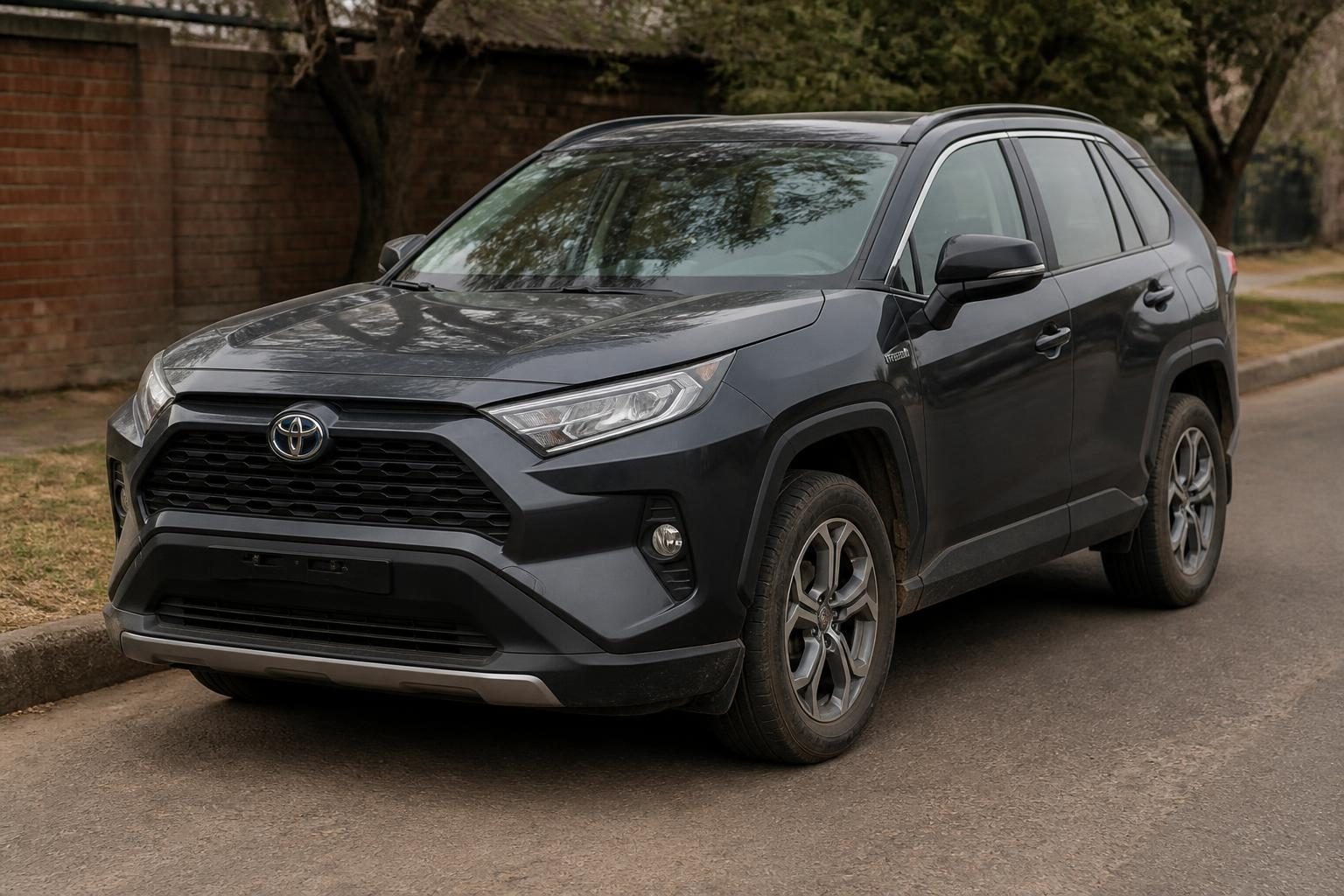 2024 Toyota RAV4
A RAV4 is not a direct replacement for a Prado on demanding rural routes. However, it may be easier to park, simpler to use around town and better suited to a smaller household. The Toyota Yaris Cross for mainly urban driving and Toyota C-HR as another compact SUV alternative are worth considering when size matters most.
| Buyer need |
Toyota Prado |
Smaller SUV |
| Rough-road confidence |
Stronger fit for demanding routes |
Better for lighter rough-road use |
| Fuel-use exposure |
Higher |
Usually easier to manage |
| Urban manoeuvrability |
Large footprint |
Easier in town |
| Passenger and load space |
Better for larger families |
Better for smaller households |
| Long-distance comfort |
Strong fit |
Depends on model and grade |
| Import assessment |
Exact age and condition need careful checking |
Eligibility still needs checking |
Toyota Prado inspection checklist
The individual vehicle matters more than general Prado reputation because Toyota’s catalogue records four main Prado series, including the 90, 120 and 150 generations and their earlier predecessor (Toyota Japan, Land Cruiser Prado vehicle catalogue, 2026).
Check these points before committing:
- Exact manufacture date, model code, engine and fuel type
- Auction grade and auction-sheet comments
- Accident repairs, replaced panels and paint differences
- Underbody damage, corrosion, leaks and chassis condition
- Suspension noise, worn bushes and uneven ride height
- Steering play, brake condition and tyre matching
- Diesel smoke, warning lights and cold-start behaviour
- Interior wear compared with the reported odometer
- Air-conditioning operation and 4WD engagement
 A mechanic inspects an SUV’s underbody and tyre while reviewing a clipboard.
The Japanese auction sheet should agree with the photographs and inspection report. An EAA Certificate of Conformity and any Japanese inspection certificate are separate matters, so confirm which documents apply to the specific shipment. No document guarantees future reliability.
How does a Japan-sourced Prado reach Zimbabwe?
A Japan-sourced Prado usually reaches Zimbabwe by RoRo shipping through Durban, followed by overland transport, with an estimated journey of about 24 to 34 days. The published import and buying guidance gives that estimate, accessed 23 June 2026. Shipping, port handling, transport and customs can affect timing.
Live listings can change, so availability should be checked on the relevant vehicle page on 23 June 2026 rather than assumed from a specification page alone. When a qualifying vehicle is listed, the buying process should provide clear vehicle details, inspection evidence, shipping documents and a vehicle-specific landed-cost estimate.
For a qualifying vehicle, Carbarn Zimbabwe’s Japan-sourced vehicles provide the Japanese auction sheet and an in-house inspection report for review before payment. Buyers can use the dashboard for invoices, inspection reports, bill of lading, certificates and vessel tracking.
Vehicle, shipping and inspection may form part of the quoted figure, while duty, applicable VAT and customs-clearance costs are separate. Review the how-to-buy guidance and the current buyer agreement before committing.
Buyer fit at a glance
| The Prado makes sense if you… |
Consider another SUV if you… |
| Travel on gravel or rural roads often |
Mostly drive in Harare |
| Carry family, equipment or luggage |
Want lower fuel use |
| Need full-time 4WD confidence |
Prefer easier parking |
| Make regular long highway trips |
Rarely need serious off-road ability |
| Accept higher tyre and suspension costs |
Want simpler ownership costs |
Verdict: Is the Prado really the ultimate SUV for Zimbabwe?
The Toyota Prado is a strong choice for rural users and frequent travellers, but it is not automatically the right SUV for every Zimbabwean buyer. Toyota’s current Land Cruiser brand history, accessed 23 June 2026, places the Land Cruiser 250 as the successor to the Prado name in Japan (Toyota Japan, Land Cruiser brand history).
Full-time 4WD, passenger space and long-distance comfort make the Prado well suited to difficult roads, heavy loads and regular highway travel. Its size and capability are useful when your routes demand them.
It is not automatically the best choice for an urban-only buyer. Fuel use, size, tyre and suspension costs, the 10-year import rule and separate landed expenses all deserve attention. Compare the Toyota vehicles available for Zimbabwean buyers, check the import rules and review the vehicle-specific landed-cost estimate before committing.