

Buying a Used Mitsubishi Outlander in Zimbabwe: When Parts Availability Matters Most
Read Our Blogs today and Learn More

The Outlander looks like a sensible family SUV for Harare traffic, school runs and longer highway trips. The harder question comes later, when you need a sensor, suspension part, transmission component or replacement lamp.
In 2026, Zimbabwe Revenue Authority guidance says used vehicles aged 10 years and above from manufacture are prohibited under the general private-import rule, subject to specified exemptions (ZIMRA, “Importation of Motor Vehicles by Private Individuals”, 2026). That makes the exact manufacture date important before you even start comparing parts.
A sound vehicle, an available part and a capable mechanic are three separate things. This guide explains how to check all three before ordering a used Mitsubishi Outlander from Japan. It also covers model codes, workshop questions, inspection reports, import eligibility and the point where a more common SUV may make better sense.
Quick Answer
- A used Mitsubishi Outlander can suit a Zimbabwean family buyer who values space, comfort and 4WD, but it is not the easiest choice if you need same-day parts.
- Parts access depends on the exact engine, transmission, drivetrain and model code.
- In 2026, ZIMRA’s guidance sets a normal private-import limit of less than 10 years from manufacture (ZIMRA, “Importation of Motor Vehicles by Private Individuals”, 2026).
- Vehicles more than five years old may face a surtax (ZIMRA, “Calculation of Duty on Importation of Private Motor Vehicles”, 2026).
- Choose the Outlander only after identifying the exact variant, checking workshop capability and accepting that some parts may need to be ordered.
Is a used Mitsubishi Outlander a sensible choice for Zimbabwe?
In 2018, Mitsubishi Motors Japan listed the Outlander with a 2.0-litre 2WD version and a 2.4-litre 4WD version. That range shows why the Mitsubishi Outlander badge does not identify one universal vehicle, parts catalogue or service plan (Mitsubishi Motors Japan, “Outlander Partial Improvement Release”, 2018).
The Outlander can make a lot of sense if you need a family-sized SUV rather than a small hatchback. Its higher driving position, cabin space and 4WD options suit buyers who regularly move people between Harare and other towns. It can also feel more settled on longer journeys than a compact city car.
The trade-off is ownership planning. A larger SUV may use bigger tyres, brakes and suspension components than a small hatchback. It can also have more electrical, transmission and drivetrain systems for a workshop to diagnose. That does not make the vehicle unreliable. It means you should confirm repair support before buying.
Model identity matters too. A 2017 Outlander, a 2018 petrol 4WD and a newer hybrid model may have very different parts requirements. The fuel classification of any listing should be verified from its documents. Even two vehicles from the same year can differ in engine, trim, drivetrain and equipment. Would your preferred mechanic know which one you are buying?
The useful distinction is between reliability and repairability. A well-maintained Outlander may run reliably, yet still create downtime if the fault is difficult to diagnose or the correct component must be sourced from outside Zimbabwe.
For background, compare this guide with how to assess a used car before buying. Condition should remain the first filter. Parts planning is the second.
What does “parts availability” really mean?
Parts availability means more than finding a matching picture online. A component may be in local stock, obtainable through a Zimbabwean supplier or require a special order from Japan. These are three different ownership experiences. The US-market catalogue reviewed here does not prove Japanese-market compatibility or Zimbabwean availability, so use a Japan-market or VIN-specific catalogue instead.
1. Local stock
Local stock means a supplier or workshop has the component on hand. This is usually the quickest route when a repair is urgent. Common service items, bulbs, wiper blades, tyres and some brake components may be easier to identify and source.
That does not prove that every local supplier carries every Outlander part. Before ordering any component, provide the chassis number or VIN, which is the vehicle identification number, together with the engine, drivetrain and part details.
2. Local supplier order
A local parts business may be able to identify and order the component for you. The supplier might use a regional distributor, an importer or an international catalogue. Waiting time, freight charges and customs handling should be confirmed for each order.
A commercial wholesale directory lists possible sourcing and consolidation routes for Outlander components across braking, cooling, suspension, lighting and transmission categories. Treat it only as a commercial sourcing lead, not evidence of Zimbabwean retail stock, national availability, workshop coverage or delivery times (TheSparePartShop, “Zimbabwe Mitsubishi Outlander Wholesale Parts”, 2026). Confirm any order with a VIN-specific quotation from an established supplier or workshop.
3. Overseas special order
A special order may be needed for unusual trim, body panels, electronic modules or drivetrain components. The supplier must identify the correct part before confirming whether it can be sourced.
This is where a cheaper-looking vehicle can become a more expensive ownership decision. The cost may include diagnosis, international freight, customs handling and time off the road. We did not identify a reliable Zimbabwe-wide survey proving how easy or difficult Outlander parts are to find. Treat local availability as something to verify with suppliers, not as a measured national fact.
Why does the 2018 Outlander show why the badge is not enough?
The 2018 Mitsubishi Outlander listing records 82,000 kilometres, a grade 4 auction result, 4WD, automatic transmission, five seats and engine code 4B12. Its petrol classification needs verification. That combination, together with the reported GG3W chassis pattern and 1,800 mm width, is consistent with an Outlander PHEV. A PHEV is a plug-in hybrid electric vehicle that can be charged from an external power source. Confirm the auction sheet, chassis plate, charging system and registration documents before treating it as either vehicle type (Mitsubishi Motors Japan, “2018 Outlander PHEV release”, 2018).
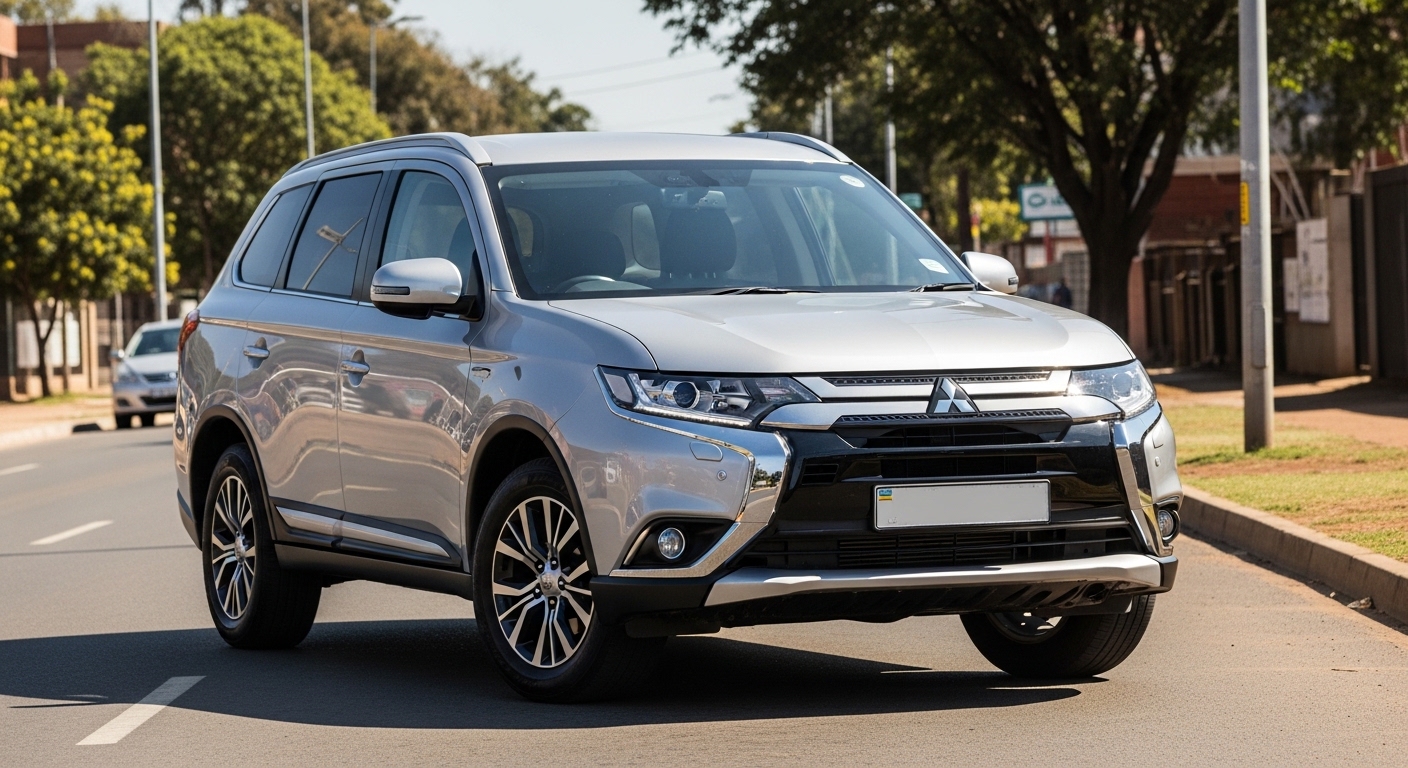 2018 Mitsubishi Outlander
The same vehicle page lists a four-cylinder DOHC 16-valve engine, a 2,670-millimetre wheelbase and dimensions of 4,695 millimetres long, 1,800 millimetres wide and 1,710 millimetres high. The width and the five-seat GG3W/4B12 combination should not be presented as a confirmed Japanese petrol specification.
For comparison, the Japanese petrol 2.4-litre version is listed with a 4J12 engine, seven seats, approximately 4,695 × 1,810 × 1,710 millimetres and 124 kW, subject to grade (Carsensor, 2026). The listing also records a clean underbody and two inspection notes covering minor exterior marks.
The inspection information is useful, but it does not prove future parts availability. A clean underbody can reduce one area of concern. It cannot tell you whether a future sensor, lamp or control module will be locally available.
The page also shows why listings should be checked individually. A 2017 example is recorded with a 2.0-litre engine, 4WD, engine code 4B11, 98,000 kilometres and grade 4. That combination is consistent with an Outlander PHEV rather than Mitsubishi Japan's 2.0-litre petrol 2WD range.
Another 2018 example has the 2.4-litre engine, 122,000 kilometres and grade 3. Its fuel system should likewise be confirmed from the auction sheet and vehicle documents. These are not interchangeable ownership profiles (Mitsubishi Motors Japan, “2017 Outlander release”, 2017).
A dated Outlander inventory snapshot from 13 August 2026 showed five listings covering model years 2017 to 2021 and odometers from 66,000 to 122,000 kilometres (Mitsubishi Outlander model page, “Current Inventory and Specifications”, 2026). Treat that as a research snapshot, not a permanent stock statement.
Which Outlander parts are easiest to plan for?
Routine service parts are usually easier to identify than model-specific electronic, drivetrain or body components. The parts material reviewed for the Outlander identifies separate categories for items such as mirrors, lamps, condensers and sensors. That reinforces the need for exact part matching (Mitsubishi Motors Mauritius, “Outlander Parts Material”, 2026).
Use the following table as a planning framework, not as a verified survey of Zimbabwean supplier stock.
| Parts category | Planning difficulty | What to confirm |
|---|---|---|
| Oil, air and cabin filters | Lower | Engine code and exact filter part number |
| Wiper blades, bulbs and tyres | Lower | Size, fitting and specification |
| Brake pads and discs | Lower to medium | Generation, engine and drivetrain |
| Suspension components | Medium | 2WD or 4WD application and model code |
| Sensors and electronic modules | Medium to high | Diagnostic fault and exact part number |
| CVT or transmission components | High | Transmission type and workshop experience |
| Body panels and lamps | Medium to high | Correct side, shape and market specification |
| Hybrid or PHEV components | High | Confirmed system type and specialist capability |
Filters and bulbs can often be planned before a vehicle arrives because their fitment is relatively straightforward. Even then, the engine and chassis details should be checked.
Braking and suspension parts need more care. A component may look similar across generations but differ by drivetrain, trim or suspension design. Ask a supplier to confirm compatibility in writing.
Electrical faults need a different approach. Do not order a sensor because a dashboard warning light appears. A diagnostic scan should identify the system and fault code first. Replacing the wrong component wastes both time and money.
The same rule applies to transmission work. A supplier listing a “Mitsubishi CVT part” has not necessarily identified the correct component for your Outlander. CVT means continuously variable transmission. The transmission code, chassis number and repair diagnosis should travel together.
Why does the Outlander model code matter?
The model badge alone is not enough to order the correct part. In 2018, the Japanese-market range combined different engine, transmission and drivetrain choices, including a 2.0-litre 2WD version with an INVECS-III six-speed sports-mode CVT and a 2.4-litre 4WD version (Mitsubishi Motors Japan, “Outlander Partial Improvement Release”, 2018).
Do not assume that the CVT description for the 2.0-litre 2WD version also describes every 2.4-litre 4WD vehicle. The selected vehicle page records a 2.4-litre 4WD model, but its fuel classification is disputed by the reported GG3W and 4B12 details. Its exact fuel system and transmission should come from the auction sheet, chassis plate and registration documents.
Give a parts supplier this information:
- chassis number or VIN;
- manufacture year and month;
- engine code;
- engine size;
- transmission type;
- 2WD or 4WD;
- petrol, hybrid or PHEV system;
- trim level;
- part number, if known;
- left- or right-hand component orientation;
- photographs of the existing component;
- diagnostic fault codes.
The phrase “2018 Mitsubishi Outlander” remains too broad for many supplier enquiries. A lamp, mirror, sensor or control module may differ by side, trim, safety equipment or market specification.
You can use the Mitsubishi specifications database to understand the model structure. Always match the database information against the exact vehicle page and original documentation before ordering.
Can a Zimbabwean mechanic service a Mitsubishi Outlander?
The live 2018 vehicle page records two condition-report notes and a completed inspection report, but neither document can confirm whether your chosen workshop can diagnose the exact vehicle. Workshop capability must be checked separately, especially for CVT, 4WD and electrical work (2018 Mitsubishi Outlander vehicle page, “Vehicle Condition Reports”, 2026).
Ask a workshop these questions before committing:
- Have you worked on this Outlander generation?
- Can you read Mitsubishi fault codes?
- Can you service the exact transmission correctly?
- Can you diagnose the 4WD system?
- Can you source parts using a chassis number?
- Do you distinguish genuine, OEM and aftermarket parts?
- Can you inspect an imported component before fitting it?
- Will you provide a written diagnosis before ordering?
- What happens if the required component must come from Japan?
- Can you safely handle a confirmed PHEV system?
Routine servicing is not the same as specialist diagnosis. An experienced mechanic may handle oil, brakes, suspension and general inspections confidently, while electrical modules or high-voltage systems require different tools and training.
If the documents confirm a PHEV, it should receive a separate assessment. Do not treat a hybrid or plug-in hybrid Outlander as a petrol model with a larger battery. High-voltage components, charging equipment and control systems require a workshop that confirms suitable diagnostic and safety capability.
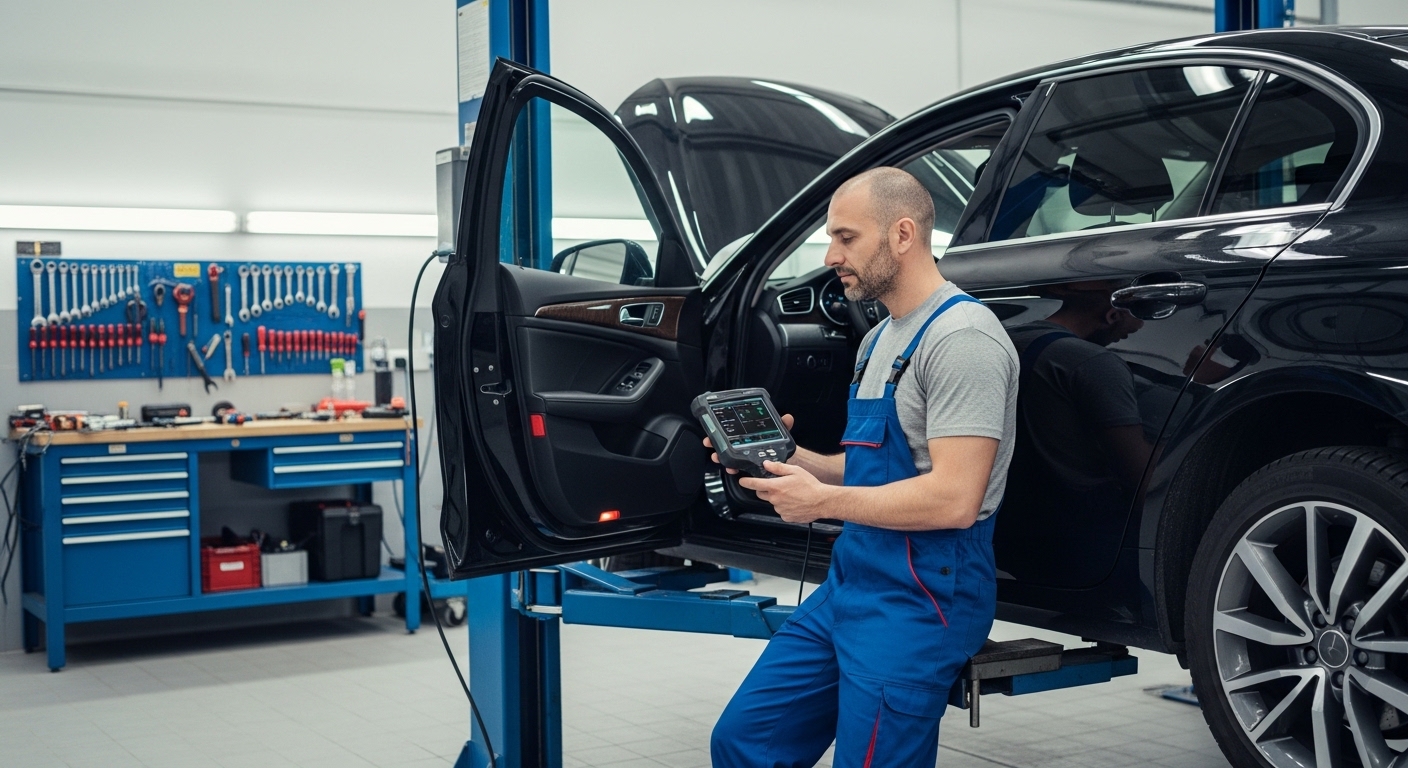 A mechanic checks a black car with a diagnostic scanner in an auto workshop.
We did not verify a nationwide official Mitsubishi service network during the research for this guide. That does not establish that no such network exists, and capable independent mechanics may still be available. Confirm support for your exact vehicle rather than relying on the badge.
What should you inspect before buying, and how old can the vehicle be?
A careful inspection can reveal future parts exposure before ordering. ZIMRA’s current guidance says used vehicles aged 10 years or more from manufacture cannot normally be imported by private individuals (ZIMRA, “Importation of Motor Vehicles by Private Individuals”, 2026).
Review these points in the auction sheet and inspection report:
- auction grade and detailed condition notes;
- accident repairs and replaced panels;
- underbody damage or corrosion;
- suspension knocks, leaks or uneven wear;
- transmission behaviour;
- dashboard warning lights;
- air-conditioning operation;
- electric windows, mirrors and tailgate;
- cameras and safety sensors;
- lamps, bumpers and body panels;
- tyres and brakes;
- missing keys, trim or accessories.
A clean-looking vehicle can still have an electronic or drivetrain fault. The inspection should test operation, not only appearance. Accident damage may also create future parts exposure through lamps, sensors, cooling components or body panels.
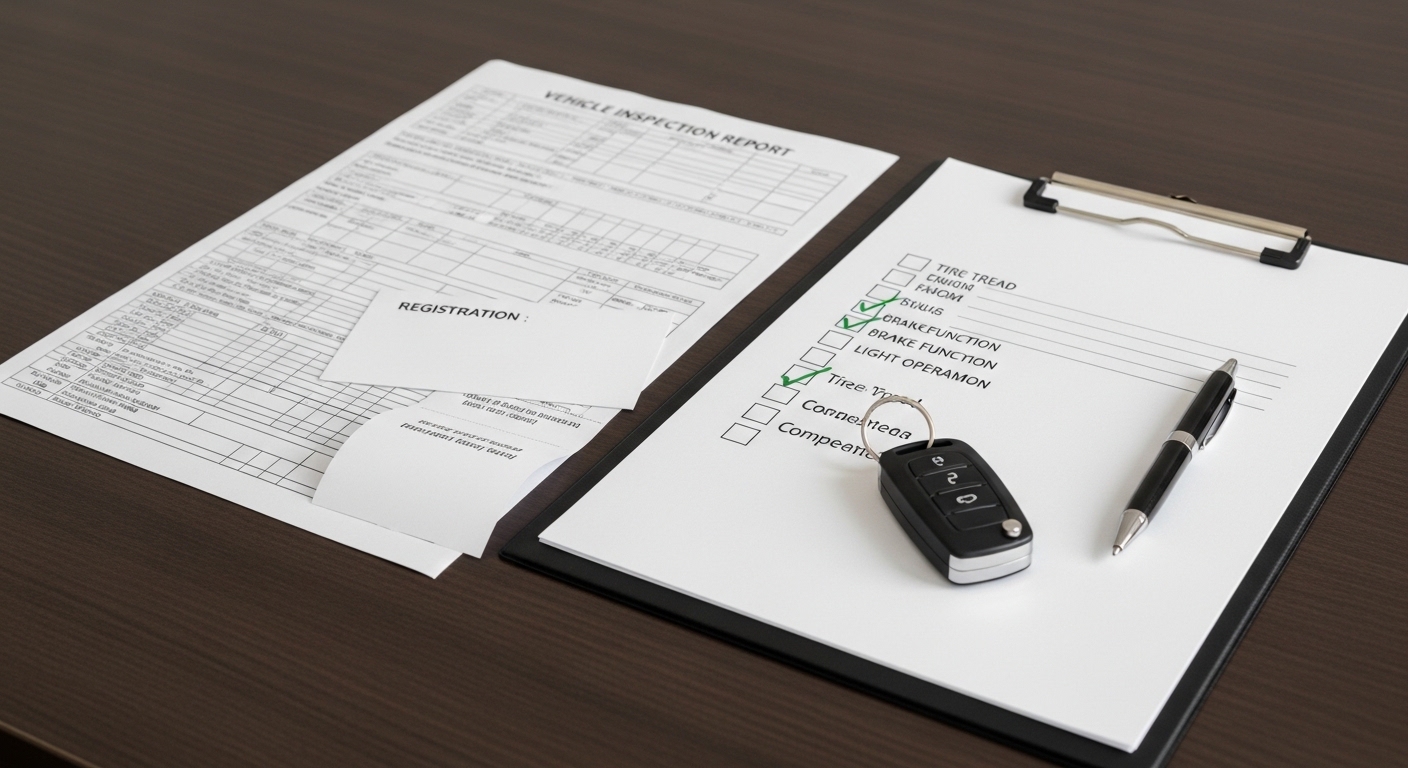 Vehicle inspection documents and checklist arranged on a desk with a car key and pen.
Manufacture date matters more than registration year. A 2017, 2018 or 2019 vehicle may each be within the normal age limit at one point, but eligibility changes as time passes. Vehicles more than five years old may also attract a surtax at importation (ZIMRA, “Calculation of Duty on Importation of Private Motor Vehicles”, 2026).
Do not compare only the Japanese vehicle figure. Duties, taxes, customs clearance and other import charges affect the landed cost. Check the current Zimbabwe import rules and vehicle eligibility guidance before paying.
ZIMRA’s Public Notice 35 of 2026 also advises prospective buyers to confirm customs-clearance details before payment. The notice refers to documents including the agreement of sale, registration book, identity documents, vehicle image and customs information where available (ZIMRA, “Public Notice 35 of 2026: Confirmation of Customs Clearance Details”, 2026).
How does the Outlander compare with a more common SUV?
The Outlander’s main ownership trade-off may be the size of the local knowledge and parts network, rather than the vehicle itself. A dated model-page snapshot showed five Outlanders spanning 2017 to 2021, confirming that model year alone does not describe one parts or service profile (Mitsubishi Outlander model page, “Current Inventory and Specifications”, 2026).
| Consideration | Mitsubishi Outlander | More common Toyota SUV |
|---|---|---|
| Family use | Strong option for buyers wanting SUV space | Depends on the model and configuration |
| Parts recognition | Exact generation and variant need checking | Often more familiar to local suppliers |
| Routine servicing | Confirm the right workshop for the exact variant | May be more familiar to some local workshops, depending on generation |
| Specialised repairs | Confirm diagnostic support before buying | Repair pathways may be more familiar |
| Used-parts market | Verify each component and model code | May be broader for some generations, but still model-specific |
| Buyer fit | Prepared owner who accepts planning | Buyer prioritising easier local support |
A Toyota RAV4 may be easier for some buyers if their local suppliers and mechanics are more familiar with that particular generation. That is a conditional buyer-fit consideration, not proof of a broader Zimbabwe-wide parts market. Condition, generation and supplier confirmation still matter.
The Outlander may suit you better if you value its cabin, 4WD availability or equipment and have already found a capable workshop. It can also work well for buyers who are comfortable planning a special-order part when needed.
A more common SUV may suit you better if same-day parts access matters most. It may also be the safer choice if you cannot identify a workshop that understands Mitsubishi diagnostics, transmission servicing and drivetrain systems.
For another family-SUV perspective, see the Mazda CX-5 ownership guide for Zimbabwean buyers. The right comparison is not “Which badge is best?” It is “Which vehicle can I maintain properly where I live?”
How does the Japan-to-Zimbabwe buying process handle an Outlander?
The published buying process states a typical 24 to 34-day journey from Japan to Durban, followed by overland transport into Zimbabwe (How to Buy a Japanese Car from Japan to Zimbabwe, 2026). That is an estimate for planning, not a promise of a fixed arrival date.
The service route should give you the information needed for parts planning before payment. Check the vehicle’s exact year, fuel type, engine, drivetrain, odometer, auction grade, inspection findings and available reports. Use the vehicle page’s landed-cost estimate as a planning reference. Import duties, VAT and customs-clearance costs are separate.
The process pages also refer to pre-shipment inspection, an EAA certificate of conformity and shipment tracking. An EAA certificate of conformity is a document confirming that the vehicle meets the required import or safety standards. The pages also list downloadable documents such as the invoice, bill of lading and inspection reports.
If you choose Carbarn, its published process says it displays legally importable vehicles and provides filters, the official Japanese auction sheet and an in-house inspection report before payment. It also describes EAA inspection, shipment tracking, invoices, bills of lading and inspection reports, and lists bank-transfer and card-payment options. Confirm the exact vehicle classification, route and payment terms directly with Carbarn before committing. Duty, VAT and customs-clearance costs should be treated as separate from the vehicle price unless current written terms say otherwise.
Sources and verification notes
- Mitsubishi Motors Japan, “Outlander Partial Improvement Release”, retrieved 2026-08-13, https://www.mitsubishi-motors.com/jp/newsroom/newsrelease/2018/20180823_1.html
- Mitsubishi Motors Mauritius, “Outlander Parts Material”, retrieved 2026-08-13, https://www.mitsubishi-motors.mu/downloads/outlandernew-min.pdf
- Zimbabwe Revenue Authority, “Importation of Motor Vehicles by Private Individuals”, retrieved 2026-08-13, https://www.zimra.co.zw/customs/importation-of-motor-vehicles-by-private-individuals
- Zimbabwe Revenue Authority, “Calculation of Duty on Importation of Private Motor Vehicles”, retrieved 2026-08-13, https://www.zimra.co.zw/customs/calculation-of-duty-on-importation-of-private-motor-vehicles-and-suspension-of-duty-on-motor-vehicle-imports-by-the-physically-handicapped-persons
- Zimbabwe Revenue Authority, “Public Notice 35 of 2026: Confirmation of Customs Clearance Details”, retrieved 2026-08-13, https://www.zimra.co.zw/public-notices?download=4520%3Apublic-notice-35-of-2026-confirmation-of-customs-clearance-details-for-motor-vehicles-before-purchase
- 2018 Mitsubishi Outlander vehicle page, retrieved 2026-08-13, https://www.carbarn.co.zw/vehicles/2018-mitsubishi-outlander-10654
- Mitsubishi Outlander model listings, retrieved 2026-08-13, https://www.carbarn.co.zw/cars/mitsubishi/outlander
- How to Buy a Japanese Car from Japan to Zimbabwe, retrieved 2026-08-13, https://www.carbarn.co.zw/how-to-buy
- Carsensor, “Mitsubishi Outlander F002M005 catalogue”, retrieved 2026-08-13, https://www.carsensor.net/catalog/mitsubishi/outlander/F002M005/list.html
- TheSparePartShop, “Zimbabwe Mitsubishi Outlander Wholesale Parts” (commercial sourcing lead, not evidence of local availability), retrieved 2026-08-13, https://www.thesparepartshop.com/zimbabwe/genuine/mitsubishi/outlander/spare-parts-suppliers.php
- Mitsubishi Motors Japan, “2018 Outlander PHEV release”, retrieved 2026-08-13, https://www.mitsubishi-motors.com/jp/newsroom/newsrelease/2018/20180823_2.html
- Mitsubishi Motors Japan, “2017 Outlander release”, retrieved 2026-08-13, https://www.mitsubishi-motors.com/jp/newsroom/newsrelease/2017/20170216_1.html
- Carbarn Zimbabwe, “Mitsubishi specifications database”, retrieved 2026-08-13, https://www.carbarn.co.zw/car-specifications/mitsubishi
- Carbarn Zimbabwe, “Zimbabwe import rules and vehicle eligibility guidance”, retrieved 2026-08-13, https://www.carbarn.co.zw/import-rules-and-regulations
- Carbarn Zimbabwe, “Mazda CX-5 ownership guide for Zimbabwean buyers”, retrieved 2026-08-13, https://www.carbarn.co.zw/blog/mazda-cx5-zimbabwe-the-suv-that-redefines-comfort-and-confidence
- Carbarn Zimbabwe, “2018 Mitsubishi Outlander vehicle page”, retrieved 2026-08-13, https://www.carbarn.co.zw/vehicles/2018-mitsubishi-outlander-10654
Frequently Asked Questions (FAQs)

Related Cars


Jason Sildir
Passionate Automotive Blogger
I am a Turkish-Australian automotive writer with a passion for hybrid vehicles and rugged 4WD adventures. My writing combines detailed technical insights with a love for outdoor exploration and Aussie driving culture. Having guest posted for leading automotive sites, my mission is to educate and inspire drivers considering greener and tougher vehicle options.

Published Date
August 13, 2026