Petrol costs make the Toyota Aqua attractive, but the Nissan Leaf promises cheaper energy for daily driving. Which one actually makes more sense in Zimbabwe?
The answer depends on more than petrol versus electricity. Here, “cheaper” means energy cost per 100 km, not total ownership cost. Purchase price, servicing, tyres, battery repairs, backup power and customs charges can change the result. You need to consider daily distance, home-charging access, electricity supply, battery condition and how often you travel beyond Harare. This comparison uses two listed Japanese vehicles to explain the running-cost logic, practical risks and buyer fit.
Quick Answer
- The Nissan Leaf can cost less per kilometre when charged reliably at home.
- The Toyota Aqua is easier for longer trips because any suitable petrol station can refuel it.
- In Toyota Japan’s 2017 Aqua G specification, fuel economy is rated at 34.4 km/L under the JC08 cycle.
- A used Leaf should be judged by battery evidence, usable range and inspection findings.
- Choose the Leaf for predictable urban travel. Choose the Aqua for flexibility and lower charging anxiety.
For broader electric and hybrid car guidance in Zimbabwe, compare both energy needs and import eligibility before choosing a model.
Nissan Leaf and Toyota Aqua: Key Differences
For buyers comparing a used Nissan Leaf vs Toyota Aqua in Zimbabwe, the key difference is how each car gets energy. In Toyota Japan’s 2017 Aqua G specification, the 1,496 cc hybrid uses a 36-litre tank and returns 34.4 km/L under JC08 testing. The Nissan Leaf example uses a traction battery and electric motor instead. The ownership difference is simple: the Aqua carries fuel, while the Leaf carries stored electricity.
The Toyota Aqua example is a 2019 S with the NHP10 model code, 77,000 km, front-wheel drive and a 1,500 cc hybrid system. Its listing records a 74 PS output and auction grade 4. The inspection records a clean underbody and no damage found.
The featured Leaf is a 2020 ZE1 E+G with 68,000 km, front-wheel drive, five seats and auction grade 4.5. The exact listing should be checked for a battery report before purchase. Battery evidence matters more than simply saying the car is newer, and even a stated SOH is not a promise about future performance.
| Feature |
Nissan Leaf |
Toyota Aqua |
| Power source |
Battery-electric |
Petrol-electric hybrid |
| External charging |
Required |
Not required |
| Refuelling |
Suitable charging point |
Petrol station |
| Main condition question |
Battery SOH and usable range |
Hybrid system and general condition |
| Strongest use case |
Predictable urban travel |
Flexible urban and highway use |
| Main ownership risk |
Charging and battery evidence |
Fuel use and hybrid-system condition |
In Toyota Japan’s 2017 Aqua G specification, the 1,496 cc engine produces 74 PS and 111 Nm, with front-wheel drive and an electric continuously variable transmission. The Leaf listing shows 0 cc as an EV placeholder, so its battery evidence and charging needs are the more useful comparison points.
Is the Nissan Leaf cheaper to run than the Toyota Aqua?
In the 9 September 2026 Zimpricecheck ZESA tariff snapshot, domestic electricity prices rise across stepped bands, from US$0.0848 to US$0.2756 per kWh including the 6% REA levy. That means the Leaf usually has the lower energy cost, but the saving depends on which electricity band your household reaches.
A transparent comparison needs five inputs: annual kilometres, vehicle energy use, charging losses, the household electricity band and the current petrol price. Nissan’s official Leaf specification lists 125 Wh/km under JC08 for the featured 62 kWh e+ G. With the article’s clearly labelled 10% planning allowance for charging losses, the illustration uses 13.75 kWh from the wall per 100 km.
The Aqua calculation uses Toyota’s official 34.4 km/L JC08 figure. The 9 September 2026 Zimpricecheck fuel update lists a petrol ceiling price of US$1.96 per litre. Retail prices can be lower, and both inputs can change, so this is a dated planning example rather than a permanent ownership promise.
ZESA domestic tariffs are stepped and cumulative, so the effective cost depends on the household’s existing monthly consumption and the marginal band reached. The USD figures below are reference equivalents; domestic customers are billed in ZiG at the prevailing exchange rate, not necessarily at these displayed USD amounts.
| Vehicle or scenario |
Calculation |
Illustrative cost per 100 km |
| Leaf, first electricity band |
13.75 kWh × US$0.0848 |
US$1.17 |
| Leaf, 51 to 100 kWh band |
13.75 kWh × US$0.0954 |
US$1.31 |
| Leaf, 101 to 200 kWh band |
13.75 kWh × US$0.1696 |
US$2.33 |
| Leaf, 201 to 300 kWh band |
13.75 kWh × US$0.2438 |
US$3.35 |
| Leaf, 301 to 400 kWh band |
13.75 kWh × US$0.2650 |
US$3.64 |
| Leaf, above 400 kWh band |
13.75 kWh × US$0.2756 |
US$3.79 |
| Aqua at 34.4 km/L JC08 |
2.91 litres × US$1.96 |
US$5.70 |
The table excludes the vehicle amount, insurance, tyres, servicing, battery repairs, public charging, solar equipment and backup power. It also uses a laboratory fuel figure for the Aqua, not a guaranteed Harare result.
The Leaf’s energy advantage can become less useful if you need to buy an inverter, batteries or solar equipment mainly to keep the car charged. The cheapest energy per kilometre does not always produce the cheapest ownership routine.
For more Nissan Leaf specification guidance, compare the reported battery condition with the vehicle’s expected daily route.
What does the Nissan Leaf do better?
Nissan’s official Leaf specification lists 400 km under JC08 for the 40 kWh second-generation Leaf. The featured e+ G has a 62 kWh battery and was rated at 570 km under JC08, or 458 km under WLTC, when new. Neither figure is a guaranteed range for a used vehicle. The Leaf is strongest as a predictable commuter because home charging, quiet driving and regenerative braking can reduce daily energy costs in stop-start traffic.
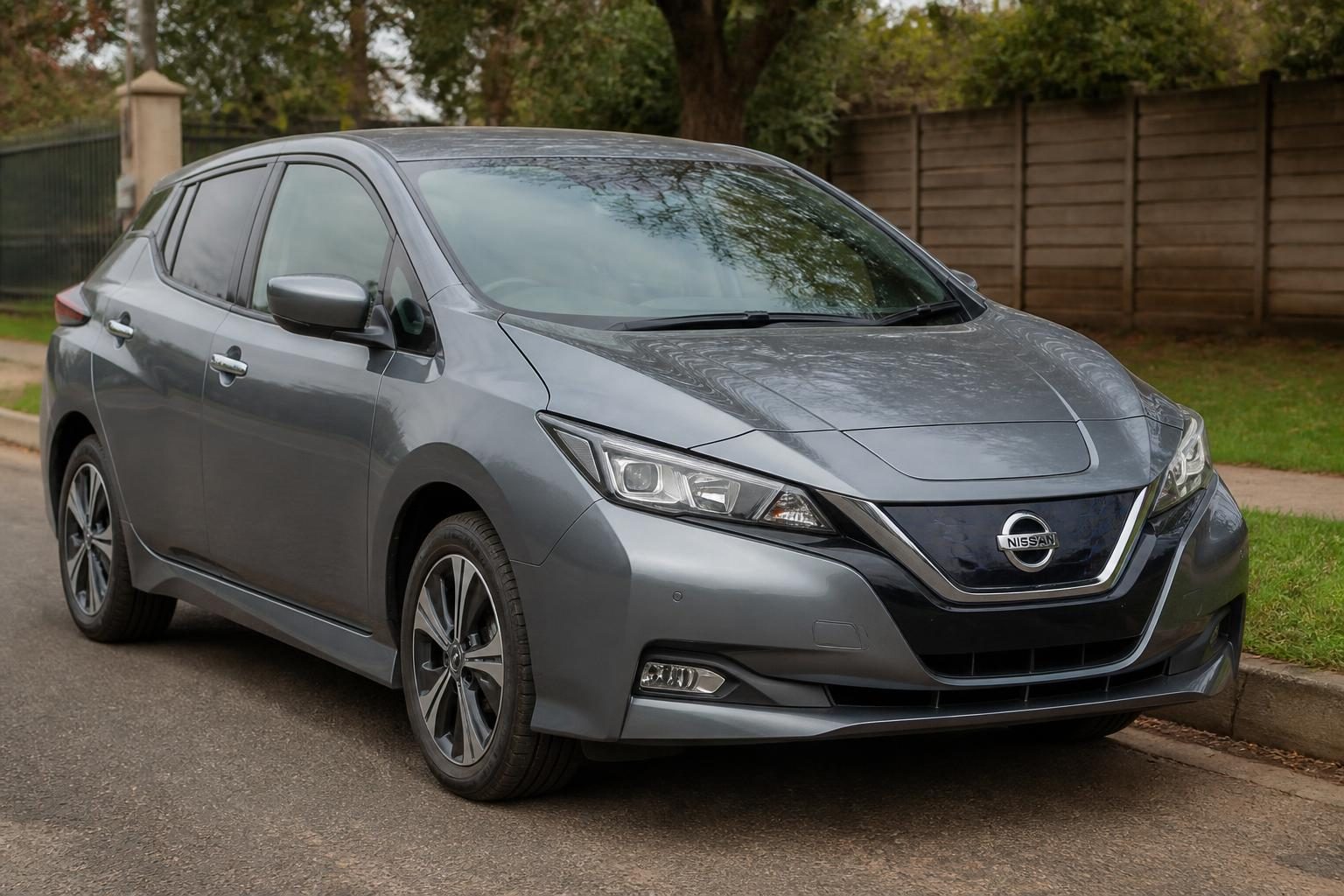 2020 Nissan Leaf
The featured 2020 Leaf has 68,000 km, a ZE1 model code and auction grade 4.5. Its inspection records a clean underbody, 4 mm front and rear tyre tread, no dashboard damage and minor bumper imperfections. Those details create a clearer starting point than age alone, but a battery report for this exact vehicle still needs checking.
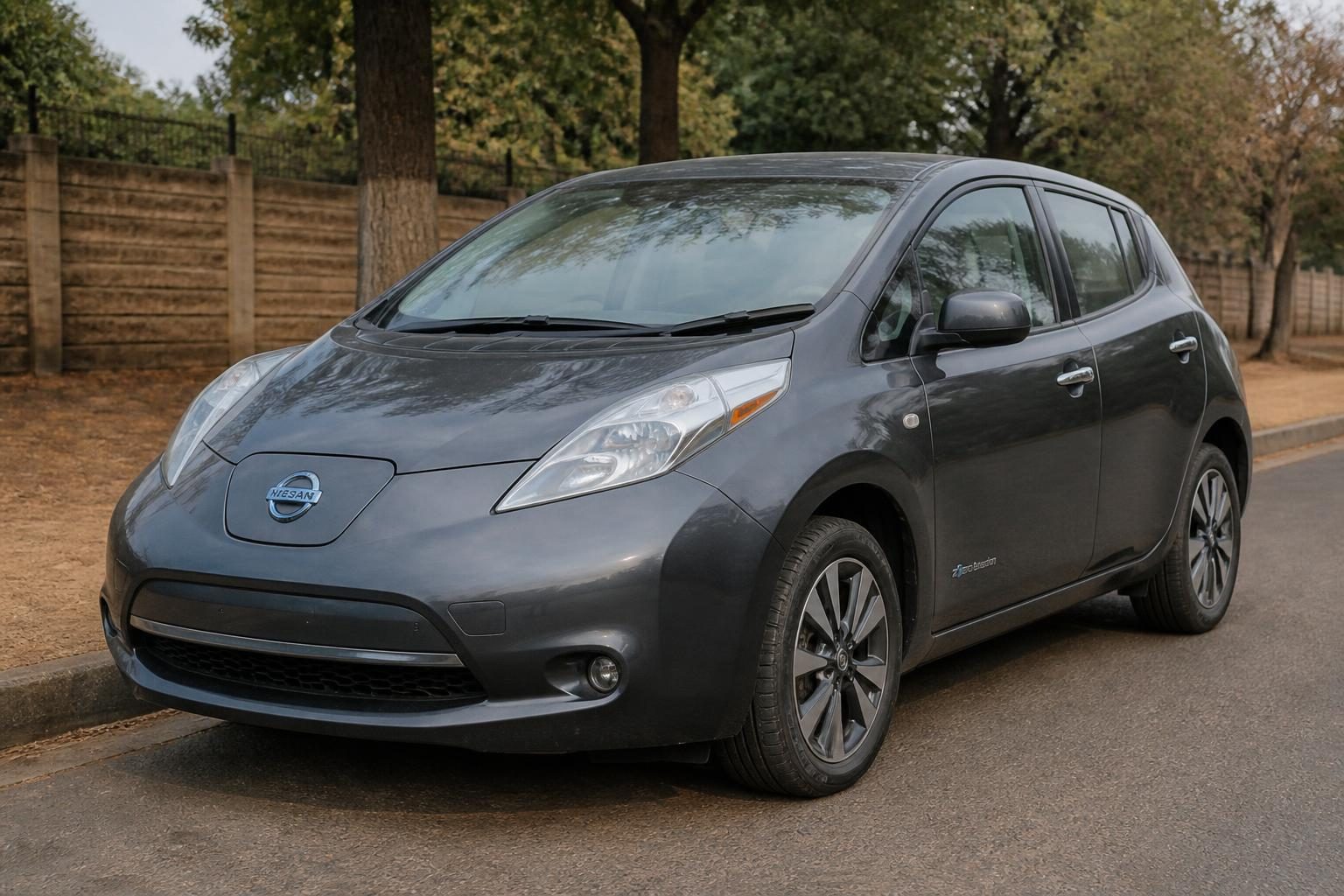 2020 Nissan Leaf E+G
Nissan’s battery guidance supports assessing the individual battery rather than relying on the model name. Check the SOH evidence, usable range at the displayed charge, cable, connector, warning lights and charging behaviour. The 400 km JC08 figure applies to the 40 kWh version, while the featured e+ G’s 570 km JC08 figure describes a new vehicle under a test cycle, not every used Leaf.
What should you verify before choosing this Leaf?
Ask for battery diagnostic evidence and confirm the exact variant. Check the displayed capacity, charging equipment, dashboard messages, auction-sheet notes and inspection report. Also compare the vehicle’s usable range with your longest regular journey.
Would the car still work for you after an overnight power interruption? If the answer is no, you need a backup charging plan or another vehicle for important trips.
According to Nissan’s official specification, the 40 kWh second-generation Leaf was rated at 400 km under JC08, while the 62 kWh e+ G was rated at 570 km. A used Leaf’s practical value depends on its individual battery condition, charging access and daily route, not on either original catalogue number alone.
What does the Toyota Aqua do better?
In Toyota Japan’s 2017 Aqua catalogue, the L grade reaches up to 38.0 km/L under JC08 testing, while the cited G specification records 34.4 km/L. The Aqua is easier to live with when electricity is uncertain because it needs no home charger and can be refuelled through the familiar petrol-station routine.
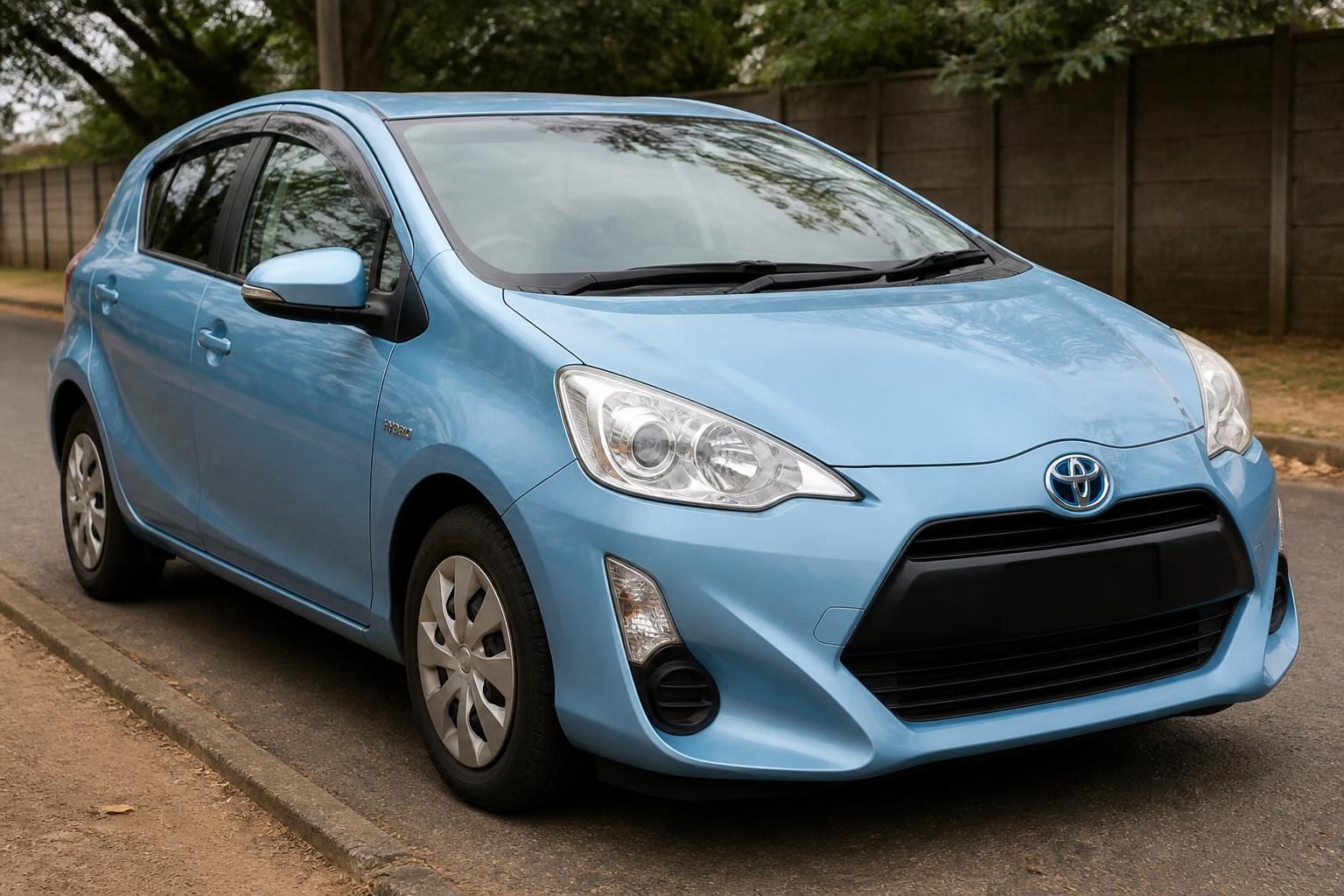 2019 Toyota Aqua
The featured 2019 Aqua S has the NHP10 model code, a 1,500 cc engine, 74 PS, front-wheel drive, 77,000 km and auction grade 4. Its inspection records no damage found, a clean underbody and 4 mm front and rear tyres. That makes it a useful benchmark, not a claim that every Aqua has the same condition.
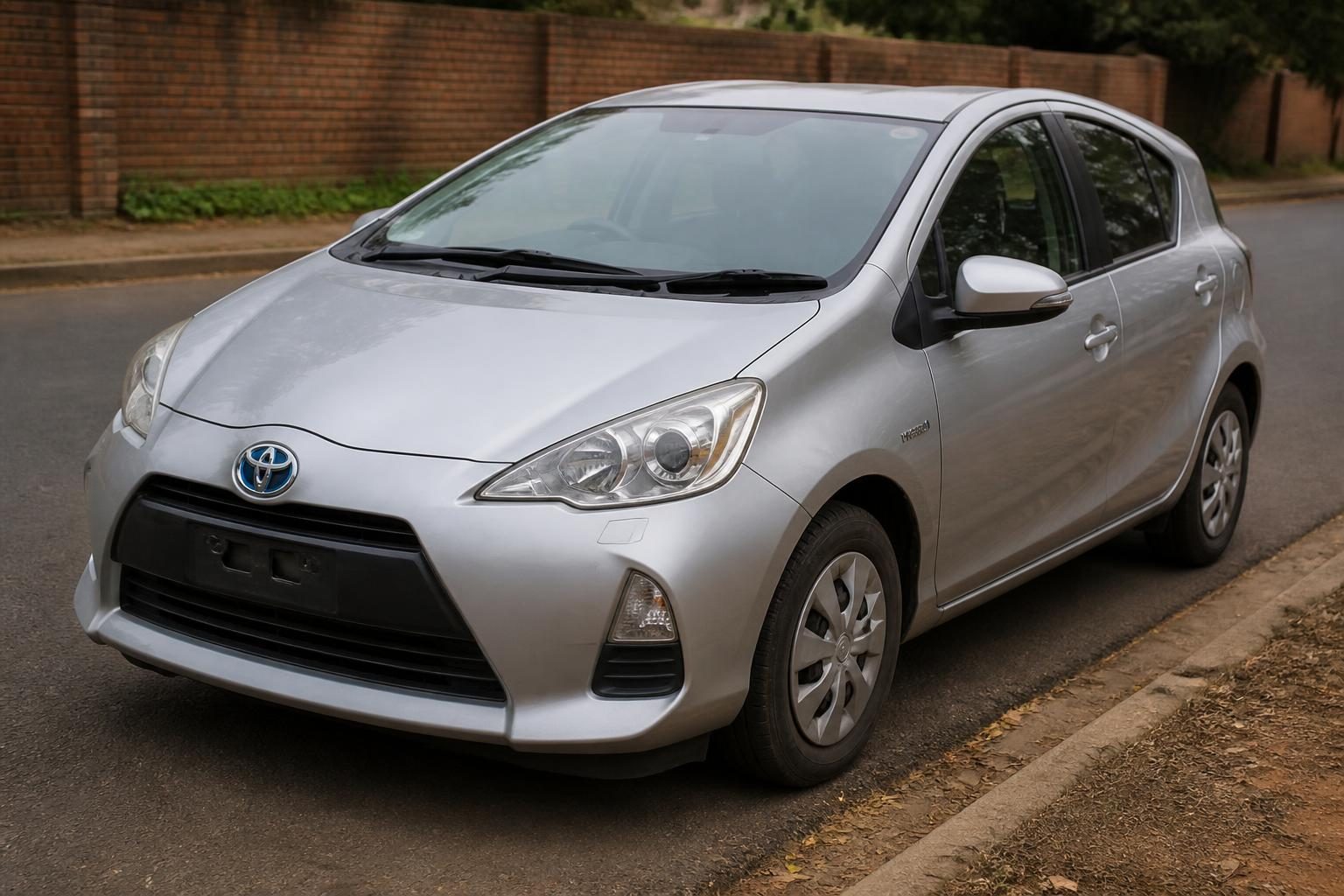 2019 Toyota Aqua S
The Aqua’s hybrid motor can assist during urban acceleration and recover energy during braking. That suits stop-start driving around Harare. It also suits buyers who make unpredictable journeys, travel between cities or want one car without planning around charging.
Actual fuel use can differ from the JC08 figure because of traffic, air-conditioning, road conditions, tyre pressure and driving style. The 38.0 km/L figure belongs to the L grade, so it should not be applied to every Aqua S or G.
The Aqua is not automatically risk-free. Check hybrid-system warnings, auction grade, odometer, tyre condition, underbody condition and the inspection report. A higher-grade, well-documented Aqua can make more sense than a lower-grade example with fewer kilometres.
Toyota Japan’s 2017 Aqua G specification lists a 36-litre tank and 34.4 km/L JC08 economy. The Aqua therefore offers strong laboratory efficiency without external charging, making it the lower-stress choice when your driving includes longer or poorly planned trips.
For Toyota specification and model information, compare the exact grade and inspection evidence rather than relying on the model name alone.
Which car suits Harare and longer Zimbabwe trips?
For a short daily commute, the Leaf can use less purchased energy, while the Aqua remains easier for mixed travel. Zimbabwe’s 2022 national electric-mobility framework identified limited charging infrastructure and electricity access as barriers, so a Leaf needs a dependable home or workplace charging routine.
Both cars can suit Harare traffic. The Leaf is particularly attractive when your route is predictable and you can charge overnight. The Aqua is stronger when your weekly pattern changes, your electricity supply is unreliable or you regularly travel beyond the city.
| Driving pattern |
Better fit |
Why |
| Short commute with reliable home charging |
Leaf |
Lower energy-cost potential |
| Frequent Harare stop-start driving |
Either |
Both suit urban use |
| Regular intercity travel |
Aqua |
Petrol refuelling is simpler |
| Unreliable household electricity |
Aqua |
Less dependent on charging |
| Second household car |
Leaf |
Daily routes are easier to plan |
| One car for all travel |
Aqua |
Greater journey flexibility |
| Strong solar or backup power |
Leaf |
Charging is easier to maintain |
Leaf or Aqua? A simple decision test
- Can you charge reliably at home or work?
- Are most journeys predictable and urban?
- Is clear battery evidence available for the exact Leaf?
- Is this your household’s only car?
Several yes answers favour the Leaf. Uncertain charging, frequent long trips or missing battery evidence favour the Aqua. The Leaf can still work for longer journeys, but route planning and backup transport matter more.
See Nissan Leaf listings for current model examples and listing details.
The Better Buy in Zimbabwe in 2026
In the 9 September 2026 vehicle snapshot, the featured Leaf records 68,000 km and grade 4.5, while the featured Aqua records 77,000 km and grade 4. Those figures show why the exact vehicle matters more than choosing EV or hybrid by reputation alone.
Choose the Nissan Leaf if you have dependable home charging, predictable daily travel and clear battery evidence. It makes the most sense as an efficient urban commuter or second household car. Treat charging access, power interruptions and usable range as purchase checks, not minor details.
Choose the Toyota Aqua if you need one car for town and longer journeys. It suits buyers who prefer quick petrol refuelling, do not want to plan around charging or regularly travel beyond Harare. Its hybrid system can still reduce fuel use in urban traffic without requiring a wall charger.
Zimbabwe generally prohibits importing used vehicles aged 10 years or more from manufacture, subject to limited official exceptions. Confirm eligibility with ZIMRA and the Ministry of Industry and Commerce before payment. Check the Zimbabwe import rules and landed-cost guidance before making a decision. For current examples, see Nissan Leaf listings and Toyota Aqua listings.
The direct answer is conditional: the Leaf can be cheaper to operate, while the Aqua is easier to own when charging is uncertain. A lower energy bill does not remove the need to assess battery condition, backup power and longer-trip planning.
How can you compare a listed Leaf or Aqua before importing?
In the published Carbarn buying guide, the Japan-to-Zimbabwe process typically uses a 24 to 34-day RoRo journey through Durban, followed by overland delivery. The guide also describes two reports before payment, dashboard tracking and a pre-shipment inspection or conformity certificate. Confirm the provider and document name on the final quotation.
Carbarn lists Carbarn-listed Japan-stock vehicles with the official auction sheet, Carbarn inspection report, vehicle photographs, odometer, auction grade and inspection findings. A pre-shipment inspection or conformity certificate is arranged before export, and the dashboard provides invoices, inspection sheets, bill of lading, named certificates and vessel tracking. The quoted vehicle service amount covers the vehicle, shipping and inspection, but duty, VAT and customs-clearance costs are separate. Carbarn’s published guidance displays VAT at 15%, but the applicable import treatment should be confirmed with ZIMRA or a clearing agent because published rates can change.