


The Toyota C-HR looks like an SUV, but the right version for Zimbabwe depends on more than its styling. You need to compare the hybrid and turbo engines, S and G grades, manufacture date, auction condition and total landed cost.
The compact shape can work well around Harare and on ordinary highways. It can also disappoint if you need a large rear cabin, a big boot or regular rough-road ability. This guide explains the key Toyota C-HR specifications, official fuel figures, import rules and checks to make before paying.
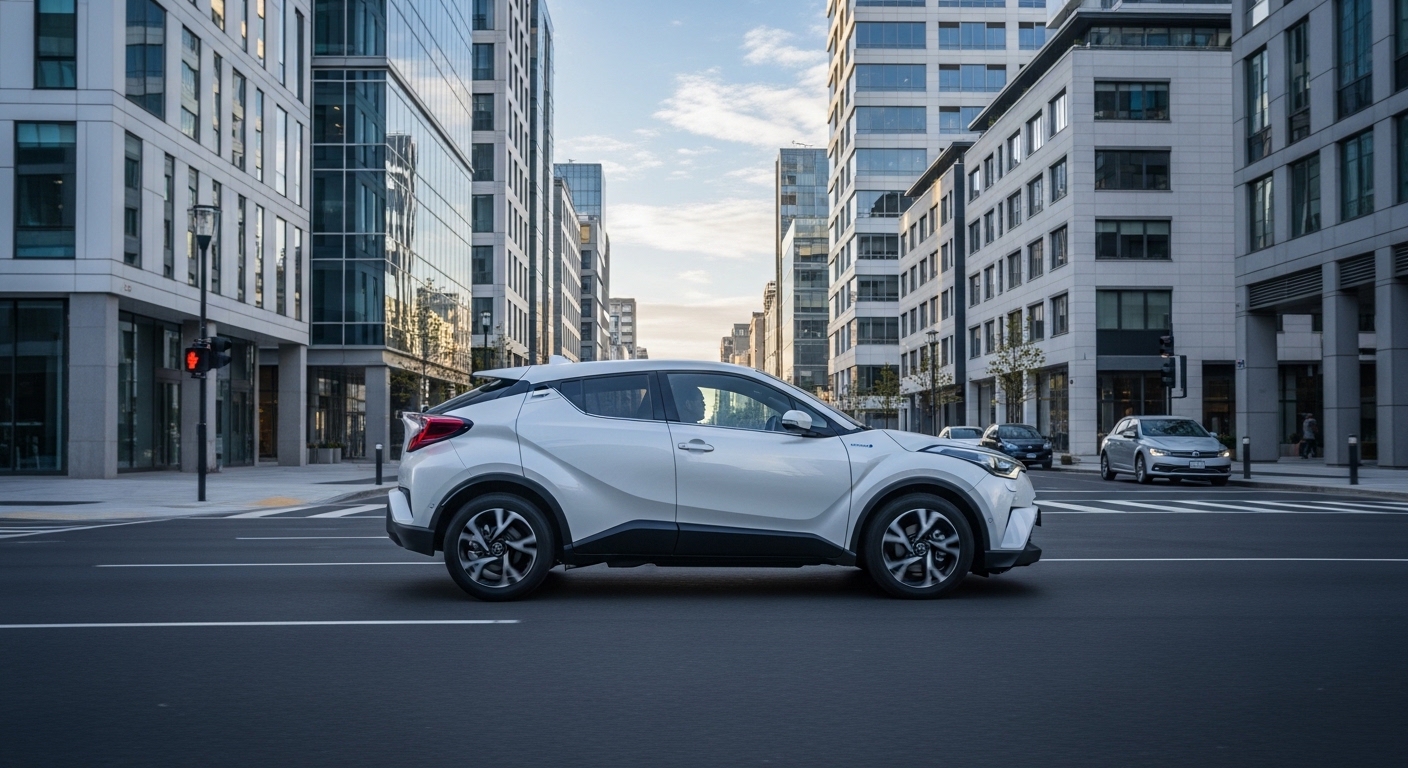 White Toyota C-HR on a clean urban street lined with modern buildings
Quick Answer
- Choose the 1.8-litre hybrid for stop-start driving and fuel efficiency.
- Consider the 1.2-litre turbo if you prefer conventional petrol operation or need selected 4WD versions.
- Toyota’s early hybrid C-HR achieved up to 30.2 km/L under the JC08 test cycle (Toyota Global, “Toyota Launches the New C-HR,” 2016).
- S and G describe factory equipment. Auction grades describe condition.
- Check manufacture date against Zimbabwe’s 10-year rule before payment.
Is the Toyota C-HR a good fit for Zimbabwe?
The Toyota C-HR is a five-seat compact crossover, according to Toyota’s Japanese catalogue. That makes it a better fit for urban drivers than large families or regular rough-road users. Its hybrid option suits stop-start traffic, while its compact body is easier to place in town than a larger SUV (Toyota Japan, “C-HR vehicle information,” 2026).
An auction grade is a Japanese auction condition rating, not a Toyota equipment grade. The C-HR makes sense for a couple, small household or commuter who wants a distinctive crossover. It should be comfortable enough for normal highway travel when the tyres, suspension and underbody are in good condition.
The hybrid system can reduce engine use in slower traffic. Rear visibility and cabin access still need a proper look. The sloping body and small rear windows can make the back seat feel less open than a conventional family SUV. Will the rear seats work with your passengers and child seats? Check the actual vehicle rather than treating this as a measured comparison.
The C-HR is not a seven-seater. It may also feel tight if you regularly carry bulky equipment, large shopping loads or several child seats. Buyers who need more room should compare a RAV4 or a Toyota people-mover instead.
The crossover stance should not be treated as proof of high-clearance off-road ability. A front-wheel-drive C-HR is better viewed as a paved-road and highway car. If your regular route includes rough rural tracks, inspect the underbody carefully and compare measured clearance with a more suitable body style.
Toyota C-HR options can be reviewed through the Toyota C-HR listings in Zimbabwe, while broader model data is available in the Toyota model specifications.
The Toyota C-HR is best suited to Zimbabwean buyers who want a compact five-seat crossover for town driving and ordinary highway use. Toyota’s catalogue confirms five seats and multiple drivetrain options, but the smaller rear cabin and crossover stance make it less suitable for large families, bulky cargo or frequent rough-road travel.
Comparing Toyota C-HR prices in Zimbabwe
A Toyota C-HR has several cost stages before it becomes an on-road vehicle in Zimbabwe. The current vehicle pages show a vehicle amount and an estimated landed cost separately. ZIMRA’s duty-calculation guidance, retrieved 15 August 2026, lists VAT at 15% and says final figures require confirmation (ZIMRA, “Calculation of Duty on Importation of Private Motor Vehicles,” 2026).
No verified ZWG price figure is published in this guide. Live vehicle amounts change with the manufacture year, engine, grade, mileage, auction condition and shipping arrangements. Converting an old foreign-currency advert into ZWG would create a number that may not match your final quotation.
Start with the individual vehicle page and its proforma invoice. Then separate the following items:
- Vehicle or CIF amount.
- Shipping and inspection inclusions.
- Customs valuation and VDP assessment.
- Customs duty and any applicable age-related charge.
- VAT and other taxes.
- Customs clearance, registration and local costs.
CIF means cost, insurance and freight. It is the value of the vehicle and its transport and insurance costs up to the relevant import point. VDP, or Value for Duty Purposes, is the customs value used to assess duties and taxes.
ZIMRA explains that vehicle valuation can consider the open-market value of similar vehicles, accepted values and the condition of the exact vehicle (ZIMRA, “Importation of Motor Vehicles by Private Individuals,” retrieved 15 August 2026).
The live vehicle amount is therefore not automatically the final landed or on-road total. Check the current vehicle page for the estimate, then confirm the final amount on the proforma invoice. Duty, VAT and customs-clearance costs should be assessed separately.
Why the cheapest vehicle is not always the cheapest import
An older C-HR may have a lower vehicle amount but face an age-related surtax. It may also need tyres, brakes or other work after arrival. A newer car can cost more at the vehicle stage yet produce a more manageable overall import bill.
[UNIQUE INSIGHT] Compare at least two or three actual vehicles using the same checklist. Look at the manufacture date, VDP, estimated landed cost, auction evidence, mileage and condition together. A cheaper advert is only cheaper if the complete import calculation remains lower.
 Vehicle paperwork and inspection notes beside a laptop, with a car visible through the window.
The amount shown for a Toyota C-HR is not the same as the final on-road cost in Zimbabwe. Buyers should compare the vehicle amount, shipping and inspection inclusions, VDP assessment, VAT, customs charges, clearance and registration separately. The individual vehicle page provides an estimate, while the proforma invoice confirms the final quotation.
The Zimbabwe vehicle import rules explain the wider import requirements. You can also review an individual Toyota C-HR listing to see how vehicle-level information is presented.
Which Toyota C-HR engine and grade should you choose?
For most urban drivers, the 1.8-litre hybrid is the strongest starting point because Toyota lists up to 30.2 km/L under JC08 for early Japanese-market models. The 1.2-litre turbo is worth considering for conventional petrol operation or selected 4WD versions (Toyota Global, “Toyota Launches the New C-HR,” 2016).
| Powertrain | Best suited to | Main advantage | Main trade-off | Verify |
|---|---|---|---|---|
| 1.8-litre hybrid | Harare traffic and mixed urban driving | Smooth low-speed operation and strong official test figures | Hybrid system evidence needs careful checking | Engine code, warnings, service history |
| 1.2-litre turbo | Conventional petrol buyers | Turbocharged petrol response | Official fuel figures are lower than early hybrid figures | Engine code, transmission and drive type |
| 1.2-litre turbo 4WD | Buyers prioritising drivetrain traction | Full-time 4WD on selected variants | It is not automatically an off-road vehicle | Exact variant and underbody condition |
Toyota’s early launch information lists the hybrid with a 1.8-litre 2ZR-FXE system and the turbo version with a 1.2-litre engine. Toyota’s later catalogue also lists CVT and 6MT versions, with 4WD available on selected turbo variants (Toyota Japan, “C-HR vehicle information,” 2026).
The hybrid is a good fit when your driving includes queues, school runs and frequent low-speed traffic. Check warning lights, service records, battery-related evidence and the condition of the cooling vents. No inspection can promise a specific future battery life.
The turbo suits buyers who want a more familiar petrol driving experience. Check the turbo response, oil leaks, cooling system and CVT behaviour. If the vehicle has 4WD, confirm that the exact model code supports it and inspect the underbody.
Official fuel economy, with test cycles separated
JC08 is a Japanese fuel-economy test cycle. WLTC is an international test cycle combining urban, suburban and highway conditions. The two cycles should not be ranked together without clear labels (Toyota Japan, “C-HR fuel economy information,” 2026).
| Powertrain or range | Test cycle | Official figure |
|---|---|---|
| Early 1.8-litre hybrid | JC08 | Up to 30.2 km/L |
| Early 1.2-litre turbo | JC08 | 15.4 km/L |
| 2018 to 2019 C-HR range | JC08 | 15.4 to 30.2 km/L |
| Later C-HR range | WLTC | 14.3 to 25.8 km/L |
| Later C-HR range | JC08 | 15.2 to 30.4 km/L |
Real consumption in Zimbabwe will depend on traffic, road speed, tyres, maintenance, load, air-conditioning use and driving style. The official figures help compare variants. They are not a promise of what your car will achieve in Harare.
What do S, G, S-T and G-T mean?
S and G are Toyota factory trim grades. The T suffix identifies turbo-petrol versions, so S-T and G-T should not be compared with hybrid S and G as if they used the same powertrain.
Toyota’s original launch information placed G and G-T above S and S-T in equipment. It listed features such as 18-inch wheels, LED front fog lamps, blind-spot monitoring, parking sonar and higher-grade seat materials for G and G-T versions (Toyota Global, “Toyota Launches the New C-HR,” 2016).
Equipment changed across model years and special editions. Confirm the exact lighting, safety systems, infotainment, cameras, seat trim and parking equipment on the individual vehicle page.
The 1.8-litre hybrid is the natural starting point for buyers focused on town driving and fuel use. The 1.2-litre turbo may suit conventional-petrol buyers or those seeking selected 4WD variants. Toyota’s official figures show 30.2 km/L JC08 for the early hybrid and 15.4 km/L JC08 for the early turbo, but both remain test-cycle results.
The Toyota C-HR specifications can be checked against the exact model year and drivetrain.
Toyota C-HR key specifications
The Japanese-market C-HR is a five-seat, five-door crossover with engine sizes from 1,196 cc to 1,797 cc in Toyota’s later catalogue. Toyota lists FF and full-time 4WD drivetrains, plus CVT and 6MT transmissions depending on the year and variant (Toyota Japan, “C-HR vehicle information,” 2026).
| Specification | What to check |
|---|---|
| Seats | 5 |
| Body style | Compact crossover |
| Hybrid engine | 1.8-litre 2ZR-FXE on the supplied 2019 example |
| Turbo engine | 1.2-litre 8NR-FTS on selected variants |
| Transmission | Automatic CVT or 6MT, depending on variant |
| Drive | FWD or selected full-time 4WD |
| Fuel economy | Official figure labelled JC08 or WLTC |
| Manufacture year | Exact date, not only registration year |
| Auction grade | Quote exactly from the auction sheet |
| Odometer | Match the listing, auction sheet and inspection report |
The supplied 2019 example records a 1.8-litre hybrid system, engine code 2ZR-FXE, FWD, automatic transmission and five seats. Its individual vehicle page corresponds to Toyota’s 98 PS (72 kW) output specification, with a 4,385 mm length and a 1,795 mm width (2019 Toyota C-HR vehicle page, retrieved 15 August 2026).
The 2019 page records a 1,550 mm height and a CVT transmission. These figures belong to that vehicle record, not every C-HR sold in Japan. Model codes and equipment can change across production periods.
Manufacture year also matters for import eligibility and cost treatment. Registration year is not a substitute for the manufacturing date. Use the auction documents and export records where the exact date is shown.
The Japanese-market C-HR variant data provides another reference point for comparing model codes and equipment.
Toyota C-HR specifications vary by manufacture year, engine, grade and drivetrain. Early Japanese examples include a 1.8-litre hybrid and a 1.2-litre turbo, while later catalogue data lists 1,196 cc to 1,797 cc engines and both FF and 4WD configurations. Confirm the exact listing against Toyota’s model data before comparing vehicles.
Can you import a Toyota C-HR into Zimbabwe in 2026?
The manufacture date controls the main age test for a Toyota C-HR import. ZIMRA states that used vehicles aged 10 years and above from the date of manufacture shall not be imported, subject to specific official exceptions (ZIMRA, “Importation of Motor Vehicles by Private Individuals,” retrieved 15 August 2026).
A 2016 C-HR therefore needs careful checking in 2026. Do not treat the model year as an automatic approval, because the exact month and manufacture date can affect the calculation.
A 2017, 2018 or 2019 vehicle may offer more practical age headroom, but eligibility still depends on the exact date and the rules in force at importation. A vehicle near the limit deserves written confirmation before any payment is made.
Do not rely on an unverified statutory-instrument summary to decide whether a particular C-HR can enter Zimbabwe. Use the current ZIMRA guidance and obtain written confirmation from ZIMRA and the Ministry of Industry and Commerce for any vehicle near or beyond the age threshold.
Older vehicles may fall within a specific statutory exception or require an applicable permission. Do not assume that an ordinary passenger C-HR can simply be imported through a licence. Commercial-vehicle exemptions do not apply automatically to a passenger crossover.
Zimbabwe drives on the left. Japanese stock is generally right-hand drive, but confirm the exact vehicle and current legal requirements rather than relying on a broad steering-position claim.
Rules can change. Confirm eligibility with ZIMRA and the Ministry of Industry and Commerce before paying for a C-HR near or beyond the age threshold.
How does the five-year surtax threshold differ from the 10-year rule?
The five-year threshold affects import cost treatment, while the 10-year threshold affects eligibility. ZIMRA’s vehicle-duty guidance identifies passenger vehicles more than five years old at importation as subject to surtax treatment, but this guide does not publish the disputed percentage (ZIMRA, “Calculation of Duty on Importation of Private Motor Vehicles,” retrieved 15 August 2026).
That distinction matters when comparing two cars. A newer C-HR may have a higher vehicle amount but a lower overall import burden. An older car may look cheaper at first and become less attractive after age-related charges.
Use this simple decision framework:
- Under five years old: compare specification, condition and the complete landed estimate.
- Over five years old: check the age-related cost treatment before assuming it is cheaper.
- Near 10 years old: confirm legal eligibility before payment.
The journey from Japan to Durban and then overland into Zimbabwe is typically quoted at about 24 to 34 days (Carbarn Zimbabwe, “How to Buy,” retrieved 15 August 2026). That is an estimate, not a delivery guarantee.
For a Toyota C-HR imported into Zimbabwe, the manufacture date matters more than the registration year. The 10-year rule concerns eligibility, while the five-year point affects cost treatment. A vehicle near either threshold needs a current review of the exact date, applicable rules and complete landed-cost estimate.
The current Zimbabwe import guidance should be checked before choosing a vehicle near either threshold.
What can a 2019 Toyota C-HR G hybrid listing tell you?
The 2019 Toyota C-HR G hybrid example records 42,000 km and an auction grade of 4.5, showing why buyers should assess the exact vehicle rather than rely on a model description (2019 Toyota C-HR vehicle page, retrieved 15 August 2026).
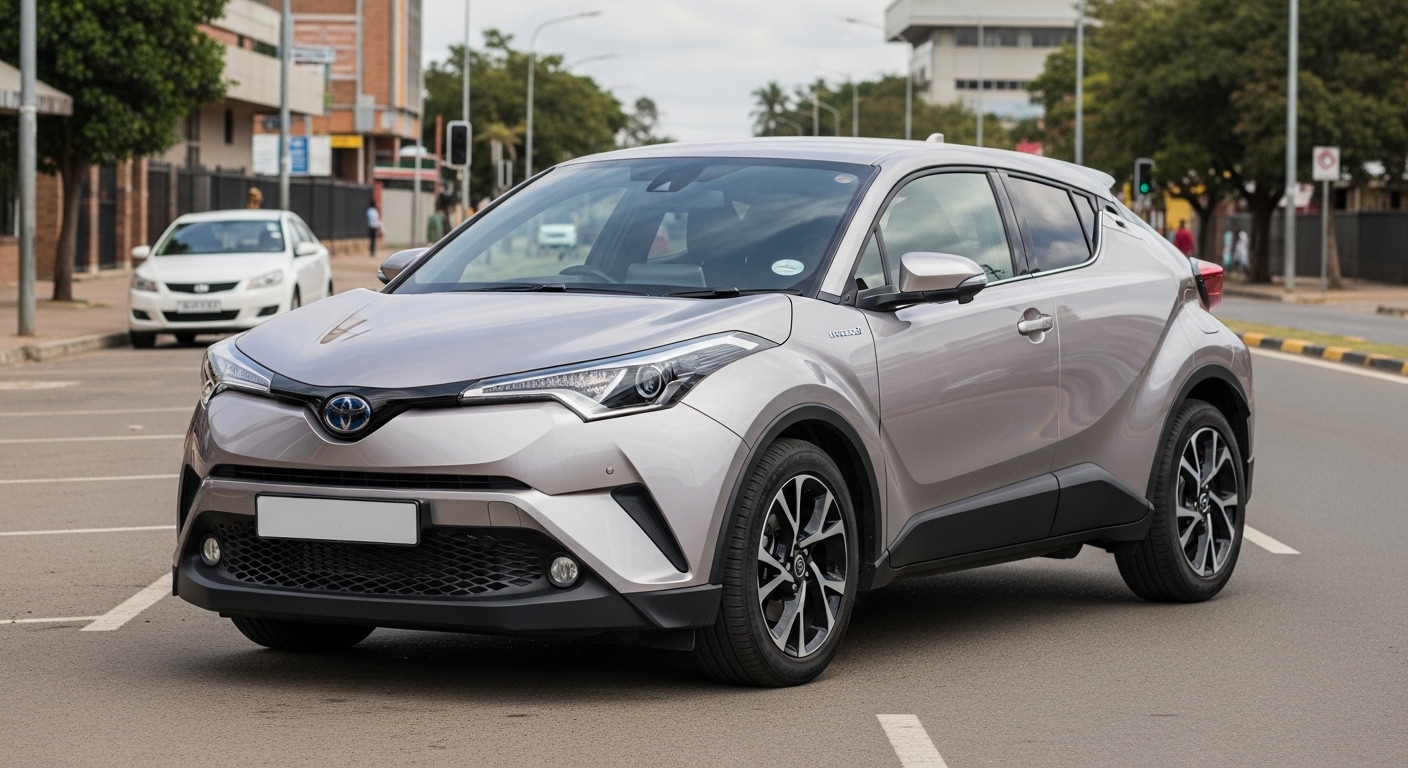 2019 Toyota C-HR
The listing identifies a G-grade, 1.8-litre hybrid with FWD, automatic CVT transmission and five seats. It records engine code 2ZR-FXE, corresponding to Toyota’s 98 PS (72 kW) output specification, and a 4,385 mm body length. These details connect the grade, powertrain and vehicle condition in one record.
The page also records an auction grade of 4.5 and no damage found in the completed inspection report. It lists clean underbody condition, no windscreen damage, no unusual interior smell and 5 mm tyre tread at both the front and rear.
| Evidence | What the reader should ask |
|---|---|
| Manufacture date | Does it remain within the current age rules? |
| G grade | Which equipment is confirmed for this model year? |
| Auction grade 4.5 | What condition evidence supports the grade? |
| Hybrid drivetrain | Are warning lights, service history and battery evidence available? |
| Odometer | Does it match the auction sheet and inspection report? |
| Landed-cost estimate | Which charges remain separate? |
A G grade describes factory equipment. It does not guarantee that every G-grade car has the same options, because special editions and model years can differ.
A 4.5 auction grade describes condition at auction. It does not mean the car is a G grade. These two labels answer different questions and should always be assessed separately.
Compare the listing photographs, auction sheet and inspection report line by line. A newer manufacture year does not replace evidence about tyres, scratches, underbody condition or service history.
A 2019 Toyota C-HR G hybrid listing can show the difference between equipment and condition evidence. The example records 42,000 km, a 4.5 auction grade, a 1.8-litre hybrid drivetrain and five seats. Buyers should still compare the auction sheet, inspection findings, manufacture date and landed-cost estimate before making a decision.
What should you check before buying a used Toyota C-HR?
A sound C-HR purchase starts with consistent documents, a clear manufacture date and inspection evidence that matches the photographs. The model pages provide two condition records on selected vehicles, an auction sheet and an in-house inspection report, so both should be read together (2019 Toyota C-HR vehicle page, retrieved 15 August 2026).
1. Check the age and cost position
Confirm the exact manufacture date first. Then check how close the vehicle sits to the five-year surtax threshold and the 10-year import limit.
Do not compare only the vehicle amount. Review the estimated landed cost, VDP treatment, VAT, clearance, registration and any local preparation work.
2. Read the auction sheet
Look for:
- Auction grade.
- Odometer reading.
- Repair history.
- Structural repair marks.
- Scratches, dents and replaced panels.
- Interior condition.
- Water or corrosion indications.
- Modifications and non-standard equipment.
An auction grade is a useful starting point, not a complete mechanical diagnosis. Read the written notes and damage map rather than relying on the number alone.
3. Inspect the hybrid system
Check warning lights, service records, hybrid battery information and cooling vents where evidence is available. Ask whether any diagnostic information accompanies the vehicle report.
Watch for unexplained engine cycling, unusual warning messages or missing maintenance records. No report can guarantee future battery performance, so keep a repair reserve in your ownership planning.
4. Inspect the turbo-petrol system
For a 1.2-litre turbo, check turbo response, oil leaks, engine noise and cooling-system condition. Confirm smooth CVT operation and verify the exact drive configuration.
For a 4WD model, inspect the underbody and confirm that the drivetrain matches the model code. Four-wheel drive can help traction, but it does not turn the C-HR into a rough-road specialist.
5. Check tyres, brakes and the underbody
Tyres can reveal alignment problems, hard use or a replacement cost waiting after arrival. Check tread, age and uneven wear. Inspect brake discs and pads where the report provides evidence.
Underbody condition deserves attention in any Japanese import. Look for corrosion, previous repairs, fluid leaks and suspension wear.
 A mechanic examines the open engine bay of a car in an auto workshop.
6. Test the cabin against your routine
Ask whether rear-seat access, rear visibility and boot space suit your household. The C-HR seats five, but its styling prioritises a compact crossover shape over maximum family practicality.
If you regularly carry bulky goods, three child seats or passengers in the rear, compare a larger Toyota before choosing the C-HR.
7. Confirm the documents
Before payment, confirm the documents required for your vehicle and route. These may include:
- Official Japanese auction sheet.
- In-house condition report.
- Proforma invoice.
- Export and registration documents.
- Pre-shipment inspection or conformity certificate.
- Bill of lading.
- Import and clearance documents.
Current process pages refer to EAA inspection and an EAA Certificate of Conformity, while other material refers to JEVIC (Carbarn Zimbabwe, “How to Buy,” retrieved 15 August 2026). The inspection provider and exact certificate wording therefore need confirmation before publication or payment.
The Japan-to-Zimbabwe buying process and import documents and clearance requirements should be checked alongside the vehicle documents.
A Toyota C-HR buyer should assess the exact vehicle, not only the model reputation. The essential checks are the manufacture date, auction sheet, auction grade, mileage, hybrid or turbo condition, underbody, tyres, documents and estimated landed cost. Two reports are more useful when their details agree with the photographs and vehicle record.
Which Toyota suits your needs better than the C-HR?
The C-HR is a five-seat crossover with a 1.8-litre hybrid option, but Toyota’s own catalogue also lists larger and smaller body styles across its range. That makes the C-HR a middle-ground choice for buyers who value compact dimensions and style more than maximum space (Toyota Japan, “C-HR vehicle information,” 2026).
The following comparisons are editorial buyer-fit judgements, not measured claims about clearance, cabin space, boot capacity or fuel use. Check model-specific specifications before deciding.
| Model | Better fit for | C-HR advantage | C-HR trade-off |
|---|---|---|---|
| Toyota C-HR | Urban drivers and small households | Distinctive shape and hybrid option | Less practical rear cabin than larger SUVs |
| Toyota Aqua | City-focused buyers prioritising economy | C-HR offers more crossover presence | C-HR is larger and may use more fuel |
| Toyota Corolla | Buyers wanting a conventional family car | C-HR offers a crossover driving position | Corolla may suit some families better |
| Toyota RAV4 | Buyers needing space or more rough-road confidence | C-HR is easier to place in town | RAV4 offers greater family practicality |
| Toyota Yaris Cross | Buyers comparing compact crossovers | C-HR offers a different styling and powertrain mix | Exact year and eligibility still need checking |
As buyer-fit judgements, the Aqua is worth comparing if your main priority is city running cost, while the RAV4 may make more sense if you need a larger rear cabin, greater cargo room or more confidence on poor roads. Confirm those differences against model-specific measurements.
A Corolla may suit buyers who prefer a conventional family car and regular long-distance travel. The Yaris Cross should be assessed by exact manufacture year, specification and import eligibility rather than by name alone.
The Toyota Aqua models, Toyota RAV4 models and Toyota Yaris Cross models provide useful comparison points.
The Toyota C-HR is a compromise between a hatchback and a larger SUV. Its five-seat layout, compact body and hybrid option suit urban buyers. People who need more rear-seat space, larger cargo capacity or regular rough-road ability should compare the RAV4, a people-mover or another practical Toyota body style.
How can the Japan-to-Zimbabwe buying process help you compare a Toyota C-HR?
A transparent import process should give you at least two condition records before payment, an exact manufacture year and a cost estimate that separates the vehicle amount from later taxes and clearance charges. The current vehicle pages show these items as separate parts of the buying decision (2019 Toyota C-HR vehicle page, retrieved 15 August 2026).
The process is import-to-order from Japan, not a local showroom purchase. You should expect to compare individual vehicle records, not choose from a generic catalogue description.
Review the following before committing:
- Manufacture date and model code.
- Engine, fuel type and drivetrain.
- Mileage and auction grade.
- Japanese auction sheet.
- In-house inspection report.
- Vehicle photographs and defect notes.
- Shipping and inspection inclusions.
- Estimated landed cost.
- Proforma invoice and separate clearance costs.
The shipping route into Zimbabwe runs from Japan to Durban, South Africa, followed by overland transport. The buying guidance, retrieved 15 August 2026, quotes the journey at about 24 to 34 days, subject to vessel schedules, border processes and other variables (Carbarn Zimbabwe, “How to Buy”).
Current process pages refer to EAA pre-shipment inspection and an EAA Certificate of Conformity, while other material refers to JEVIC (Carbarn Zimbabwe, “How to Buy,” retrieved 15 August 2026). Confirm the inspection provider and exact certificate wording before payment.
The how to buy a Japanese car and import rules and regulations pages provide the relevant process references.
The Toyota C-HR listings can be compared with the 2019 Toyota C-HR G hybrid example and the Toyota C-HR specifications reference. Carbarn Zimbabwe lists Japan-sourced vehicles for import to Zimbabwe, provides the auction sheet and in-house inspection report before payment, arranges the inspection named on the confirmed quotation, includes the stated vehicle, shipping and inspection items shown on the quotation, provides a dashboard for invoices, inspection reports, certificates, bill of lading and vessel tracking, and ships by RoRo from Japan to Durban before overland delivery into Zimbabwe.
The Japan-to-Zimbabwe process works best when the buyer compares documents and costs at vehicle level. An individual listing can show the manufacture year, mileage, auction grade, two condition reports, inspection status and estimated landed cost before shipment. The route to Zimbabwe is through Durban, with a typical quoted transit period of 24 to 34 days.
Which Toyota C-HR makes sense for you?
The Toyota C-HR is probably the best fit for an urban buyer who wants a five-seat crossover and values hybrid efficiency more than maximum space. Toyota’s early catalogue figures reached 30.2 km/L JC08 for the hybrid, while the model’s five-seat layout limits its usefulness for larger households (Toyota Global, “Toyota Launches the New C-HR,” 2016).
Choose the 1.8-litre hybrid if you mostly drive around Harare, want smooth low-speed operation and can verify the hybrid system evidence. Choose the 1.2-litre turbo if you prefer conventional petrol operation or need a specific 4WD variant.
Choose G over S when the exact equipment justifies it. Do not pay more for a trim badge without checking the model-year specification. A higher Toyota grade is not the same as a higher auction condition grade.
Most importantly, compare the manufacture date, age-related cost treatment, auction sheet, inspection report and complete landed estimate. The displayed vehicle amount is only one part of that decision.
You can compare Toyota C-HR listings in Zimbabwe after checking the rules and cost distinctions above.